As an Amazon Associate we earn from qualifying purchases.
The short answer
A side-cut opener is worth considering if lifting a loose lid is the part of opening a can that you dislike. It separates the lid at the side of the rim, and some tools provide a separate way to lift the lid away. Keep a familiar traditional opener if it already fits the tins you buy and you are comfortable with how it releases the lid. If holding two handles closed or turning a knob is the real problem, compare the controls separately. A manual side-cutter still needs your hand to turn it.
Look at the cut before looking at the handle
A traditional rotary opener normally cuts into the lid near its outer edge. The part you lift away comes from inside the can's top rim. A side-cut opener works around the outside of the rim or just below it, depending on the model. That changes where the metal separates and can change the shape of the part you remove. Look at the instructions for where the cutting wheel sits. Pictures that only show a closed tool from the front can make the two mechanisms look more similar than they are.
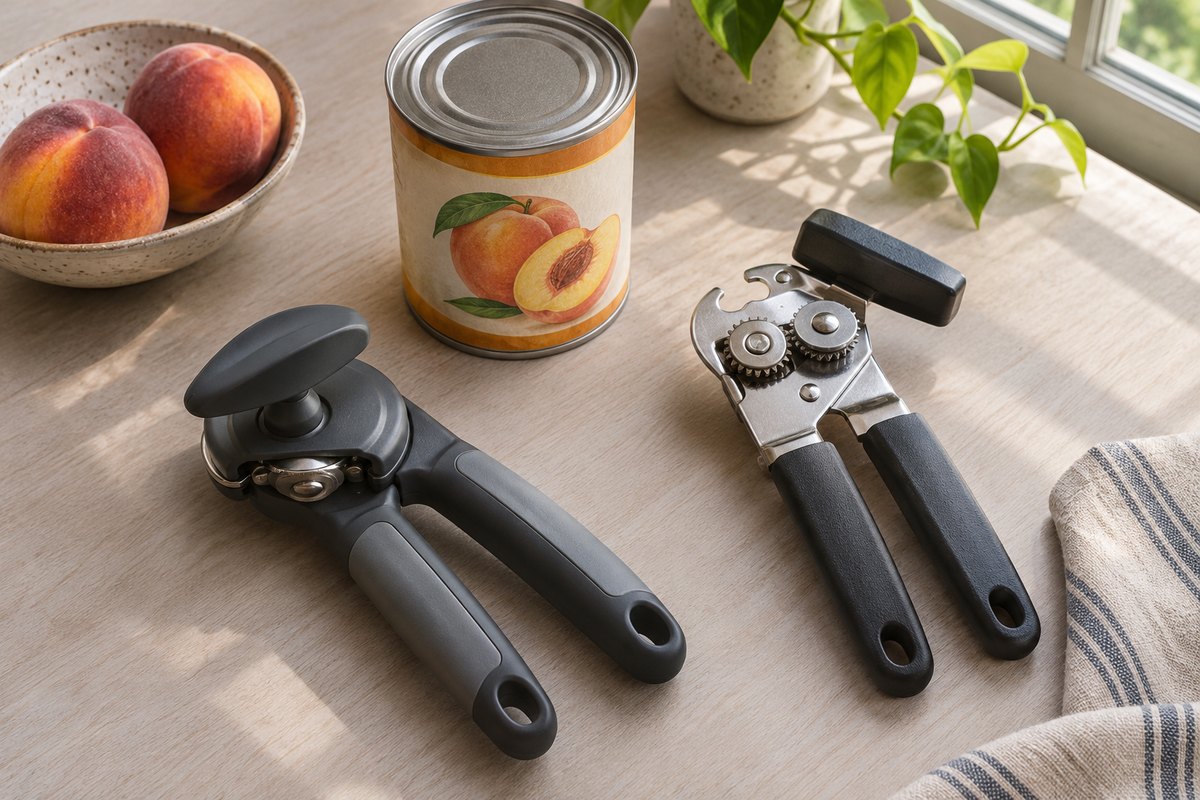
A label like smooth edge usually describes where or how the tool cuts. It does not tell you where to put your hand, how much room you need on the counter or whether the cutter fits a certain can. An opener can be a side-cutter with a hand crank or a side-cutter with a motor. If you want to relieve a repeated turning motion, make that a separate requirement rather than relying on the cut style. Our comparison for cooks with weaker grips explains what each control can change.
Three designs you can distinguish in the instructions
The models below are examples of distinct designs. The details come from the manufacturer product pages and the OXO side-cutter instruction sheet. We did not inspect their edges under the same conditions or measure cutting force. The comparisons identify where to seat the tool and what the maker provides for removing the lid.
| Design | Cutting position | What to check |
|---|---|---|
| Traditional rotary | Near the edge of the top lid | How the tool releases and the lid lifts |
| Manual side-cut | Along the outer rim | How to operate the lid pliers |
| Powered side-cut | Along the side at a fixed head | Can clearance and lever hold time |

Traditional manual example: OXO Good Grips Manual Can Opener And Bottle Opener Soft Easy-Grip Handle
OXO lists a stainless steel wheel, cushioned handles and a large turning knob on the Soft-Handled model. Consider this if you already like a conventional rotary setup. Plan how to release the cutter and lift the lid as shown in the manual.
View on Amazon (opens in a new tab)
Manual side-cut example: OXO Good Grips Smooth Edge Manual Can Opener No Sharp Edges Soft Grip
OXO lists a wheel that cuts below the can's edge and lid pliers that grip the separated lid. The pliers are an extra control to learn. Look at the instruction drawing before buying if lifting the lid is your main concern.
View on Amazon (opens in a new tab)
Countertop side-cut option: Hamilton Beach Smooth Touch Electric Can Opener With Easy Push Down Lever
Hamilton Beach describes the 76606ZF as a side-cut machine with a push-down lever held through the cut. Verify the suffix before buying. This makes sense when you can bring the can to a fixed opening head and prefer to avoid turning a crank.
View on Amazon (opens in a new tab)- OXO Soft-Handled specifications.
- OXO Smooth Edge seating and lid pliers instructions.
- Hamilton Beach Smooth Touch 76606ZF cutting and lever details.
Follow the lid through the entire sequence
Decide where you will put the lid before you open the tin. A can beside a cutting board or a crowded sink may be easy to start and awkward to finish. Leave clear space beside the can or the machine. A lid held by a pair of pliers still has to be moved and released somewhere. Think about the arc your hand will travel. If it passes over a pot or a dish full of food, put the disposal area closer before you start.
The OXO Smooth Edge uses a separate grip feature after cutting. The instructions show how to place the pliers at the edge and lift. This is not the same motion as turning the main knob. If you are comparing several models in a store, look at the pliers control rather than judging only the size of the crank. For already-owned tools, our side-cut setup guide explains what to identify in the instruction diagram.
Do not feel along a cut rim to decide whether it is safe to touch. If you see an irregular section where the tool lost contact, set the can down and work out what happened before trying to lift anything. An interrupted cut and a fully separated lid are different situations. See the guide to an incomplete cut if the wheel stopped in the middle, or the guide to an unexpectedly sharp edge if the lid came away unevenly.
Match the opener to your pantry
Check the rim on the cans you buy most often. Small tins, tall pantry cans and broad food-service cans may leave very different amounts of room for a tool to seat. A side-cut model needs the rim shape specified by its manufacturer. A countertop machine also needs room for the can to approach its head while upright. If you use a large tin only a few times a year, decide whether you want your main opener to accommodate it or would rather keep a separate tool for that job. Our larger-can guide explains which measurements to check.
If almost everything you buy has a pull tab, compare how often you would use the cutter at all. A dedicated pull-tab aid changes the motion of lifting a ring. It will not cut a plain lid, so keep that difference in mind when making a shortlist. If you often buy both kinds of packaging, check the exact opener instructions for those two types before expecting one tool to handle them. The number of functions on the packaging cannot substitute for a clear drawing of where the head goes.
When the difference is worth paying for
A side-cutter is worth trying if the cut and release step is what makes you postpone using the opener you already own. If you only open an occasional plain-lid tin and are happy with your current release routine, the benefits may be minor. A change of style also means learning a new placement, which can be more work than keeping a familiar tool. Our manual opener guide compares other grip and knob options if that is the problem you are trying to solve.
Look at the total operation before replacing anything. A countertop side-cutter occupies a fixed spot and needs power, but it takes repeated cranking out of the job. A manual side-cutter goes in a drawer and can travel, but you still have to hold it in the right position and turn it. In a shared kitchen, leave the instructions nearby for the first few uses. A person who knows how to position a conventional blade may instinctively put a side-cut tool in a different place from where its maker intends.
One way to decide is to describe the last tin that gave you trouble. If the lid dropped into the can after the cut, focus on how a replacement captures or lifts it. If the wheel jumped off the rim, look for a setup diagram that matches your tins. If you had to stop because your fingers tired, look at the grip or power control. Those problems can occur with the same can, but buying for the wrong one leaves the most difficult step unchanged. Give the problem that occurs most often more weight than a feature you would only use once in a while.
For example, someone who regularly opens one small tin over a bowl may prefer a simple tool that can be set beside the bowl and cleaned immediately. A cook who opens several full cans at once may be more concerned with having a repeatable place for the removed lids. A stationary tool can give the latter cook a fixed cutting point, provided there is enough room for the tins and for a clear disposal area. If neither kitchen has room to lift the can to a fixed head, compare handheld controls before committing to an appliance that lives on the worktop.
Frequently asked questions
Are all smooth-edge openers electric?
No. Manual and powered side-cut designs are both available. Compare the way you start and stop each tool separately.
What does the lid pliers feature do?
On the OXO Smooth Edge it grips and lifts the separated lid. Follow the maker’s placement diagram.
Does a side-cut opener fit every tin?
Check the exact model’s rim instructions and clearance. The label describes a cutting style, not all supported sizes.
Can I test for a sharp edge by touching the lid?
Avoid running a finger along cut metal. Use the manufacturer’s removal method and keep hands away from a visibly uneven or incomplete cut.
When should I keep a traditional opener?
If you are comfortable with how it cuts and releases your usual lids, switching mechanisms may offer little advantage.
Our verdict
Choose by the part you want to improve. Compare the side cutter if you want a different cutting path and a different way to remove the lid. Keep the traditional crank if it suits your hand and your usual tins. Choose a power control for the motion it removes, then check rim compatibility and lid release for the exact model.