As an Amazon Associate we earn from qualifying purchases.
Compare the movement that gives you trouble
If squeezing two handles and turning a knob makes can opening difficult, an electric cutter is the more useful design to compare. A manual opener can still make sense if you can comfortably hold and turn it and only want a better handle or a different cut. Think about what happened the last time you opened a tin. Did you struggle with the initial squeeze, the repeated turn, or raising the can? A motor changes the turn. Depending on the layout, it may still leave you with the lift and lid removal. Those are worth checking before you spend money.
The Mayo Clinic guide to joint protection recommends considering an electric can opener to avoid the strain of turning a handheld manual cutter. It also discusses larger, cushioned grips. Our comparison applies those ideas to how the tools operate. We did not measure grip force or assess whether any model changes a reader's symptoms. If either design is uncomfortable to use, stop and change the setup or ask for help rather than pushing through the action. For the full opening sequence, see the weak-grip tutorial.
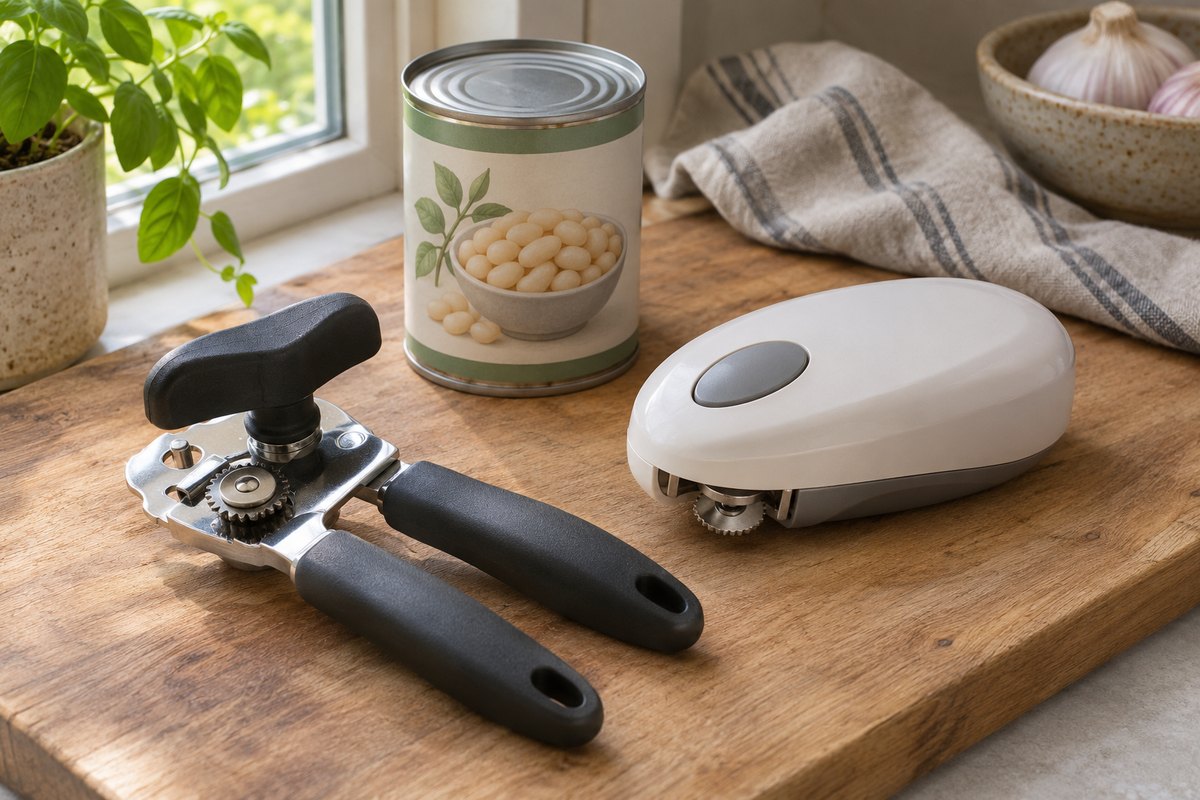
A manual tool gives you direct control of the turn

OXO Soft-Handled if you can comfortably squeeze and turn: OXO Good Grips Manual Can Opener And Bottle Opener Soft Easy-Grip Handle
The conventional two-handle model pads the grip and uses a large knob. The user still supplies the clamp and turn.
View on Amazon (opens in a new tab)The Soft-Handled OXO review explains how the crank sits relative to the handles. If narrow metal handles press awkwardly into your palm, compare the contact surfaces with the lid in its usual working position. A large handle you can comfortably pick up in a store may be harder to close once the wheel is on a rim. If possible, compare how far the grip opens and where your fingers sit when it is closed. A cushioned handle can feel better while leaving the same squeeze to maintain.
Manual cranking also appeals to cooks who want a small tool and like knowing they can stop turning immediately. The work can add up when you need several cans for one meal. If you can easily open a single small tin, think about whether the same hand position is comfortable for the third can in a batch of soup. Check the path of the knob on a short tin, too. If you normally use left-hand placement or a seated worktop, see the left-hand setup guide for ways to check reach before starting.
Check the trade-off between a light tool and a large handle. They can make different parts of the task easier. A broad knob can give you more places to put your fingers, whereas a light handle makes the tool easier to retrieve and carry. Neither tells you how much pressure you will need to maintain once the rim is engaged. When comparing two manual options, use the same hand position for both and look at how far your thumb has to travel. If your old opener has a stiff hinge or a damaged wheel, compare against a sound example instead of assuming every manual tool will feel the same.
A handheld motor leaves the can on the worktop
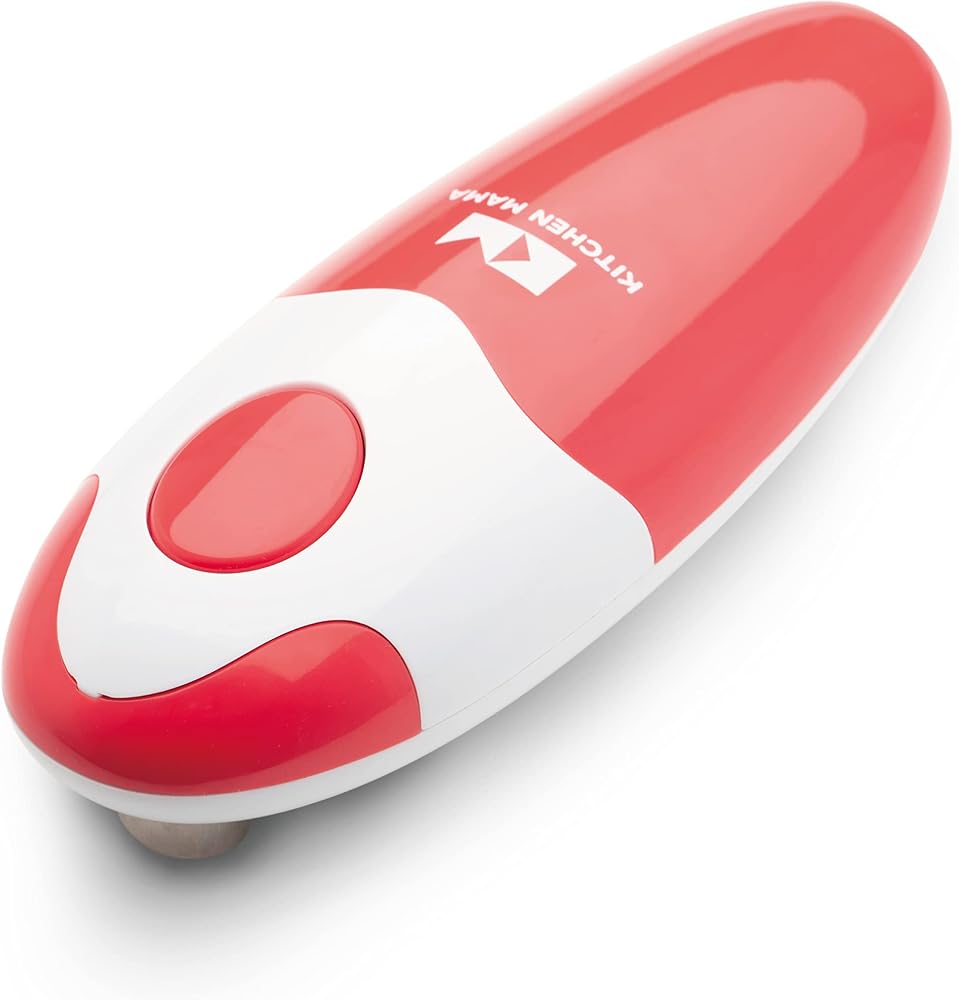
Original Kitchen Mama Auto for powered turning without lifting the tin: Kitchen Mama Auto Electric Can Opener Battery Operated Red
The original Auto uses four AA alkaline batteries and separate start and stop presses. Check compatible rim shapes.
View on Amazon (opens in a new tab)The original Auto review walks through its placement and controls. Place the can on a level worktop and bring the tool down as the instructions show. The motor performs the movement that used to come from your wrist and fingers. The second press still matters. If reaching back to the button is uncomfortable or easily forgotten, compare an automatic-stop model in the guide to one-touch controls.
Check the actions outside the cut. Can you take the tool out of its drawer and remove it when the cut finishes? Can you get a secure grip on its sides without turning the can with it? What will you do when the batteries run down? These are worth asking even if the start button looks easier than the crank. Put the tool where you can pick it up while the can stays upright. Leave a landing spot for it and a separate spot for the lid. If someone else installs batteries, agree where the next set will go.
A countertop motor gives you a stationary lever

Cuisinart CCO-50BKN for automatic stop at a fixed station: Cuisinart Deluxe Electric Automatic Can Opener CCO-50BKN
Bring the can to the cutter. The motor stops after the cut, and the removal step follows the exact model directions.
View on Amazon (opens in a new tab)The black Cuisinart review covers the cutting lever and magnetic holder. A fixed station can work well when you know where your hand will reach each time and can comfortably bring the tin to the head. If lifting a full can is the part you want to avoid, it may make more sense to move a handheld cutter to it. Keep a flat section of counter near the machine for the opened can, and check the directions for lids that will not stick to the magnet.
Clean up and storage can tip the decision. A countertop tool with a removable lever may be practical if you have space to remove and dry the assembly. It also needs an accessible outlet. If you have to carry it from a cupboard for every use, add that lift to the comparison. A manual cutter typically has fewer power and storage considerations, while a battery model needs somewhere dry and accessible to keep its housing and spare cells. The electric opener care guide explains how to check the exact cleaning instructions.
For a worktop shared by more than one person, ask where the power cord and the loose lid will go when someone else is cooking. A stationary lever can be convenient when the machine is on a clear stretch of counter. It may be less useful if the only outlet is behind the dishes or beside the stove. If one person opens cans and the other drains them, set out a place to hand off an opened tin on the worktop. Avoid changing who supports the can while the tool is still engaged. A layout that suits the whole meal has an advantage over one that merely saves a turn.
Try the same task with two ordinary cans
Choose a short tin and a taller tin that you buy regularly. With both closed, test where each would sit during setup. Check your line of sight and how you would approach the control. Consider the place for the lid afterward. Then decide which step is the hardest with the tool you already own. Changing from a manual crank to a handheld electric cutter can be a straightforward answer when the turn is the obstacle. If the fit of the rim or the position of the lid is what gives you trouble, read the guide to cutting paths before ordering.
If you are buying with someone else, let the person using the tool decide whether the new action feels manageable. Someone comfortable with a fixed lever may still need help with a heavy tin. Someone who can place the handheld model may want a different place to set it after the cut. The goal is a repeatable setup for a familiar meal, including the part after the lid separates.
If the new tool is only for a dish you make occasionally, check whether a different package would solve the problem first. Some ingredients are sold in cartons, pouches or cans with a pull ring. Each closure still has to suit your grip. Read the packaging and compare the exact action it asks for. A ring pull needs a lift and can require a firm hold on the can. Buying smaller packages can make lifting easier, even if it changes how often you open a container.
Compare two familiar cans while they are still sealed. With the Soft-Handled crank, notice whether keeping the handles closed or repeating the turn is the first uncomfortable movement. Use the Auto instructions to judge whether the placement and second button press are within easy reach. Then check the mounting height shown for the Cuisinart Deluxe. If lifting is already uncomfortable with the full tin, a fixed motor solves the crank motion at the price of keeping that lift.
Frequently asked questions
Does an electric cutter remove the squeeze and turn?
Its motor turns the cutter. Check how you will place the tool, start it and remove the lid.
Are larger handles enough?
They can change the grip. If you cannot hold the handles closed comfortably, compare a design with a different mechanism.
Do all electric cutters stop automatically?
Check the exact model. The original Auto requires a second press. The CCO-50BKN stops automatically after cutting.
Which choice avoids lifting the can to a head?
A compatible handheld electric model can be placed onto a can on the worktop.
The verdict
Choose a manual tool for a familiar grip and compact storage when turning remains comfortable. Choose an electric layout when the squeeze or turn is the issue. Compare lifting, stop behavior and lid removal to decide between handheld and fixed-head options.