As an Amazon Associate we earn from qualifying purchases.
The short answer
Pick Kitchen Mama Auto if you want to leave the can on the worktop and place the opener on its rim. Pick Cuisinart Chrome Deluxe CCO-55 if you want a fixed opening head, have an outlet in the right place and can raise the can to it. The two machines also leave you with different jobs after the cut. The original Auto asks for another press to stop. Cuisinart lists a magnetic holder on its removable arm. Read the lid removal instructions for either one before deciding.
What the controls change
With the original Auto, start with a can that is sitting upright on a firm worktop. The opener comes down to meet the rim. Once the head is positioned as shown in the instructions, press the top button. Kitchen Mama describes a second press after the cut to stop the tool. Check that you will be able to get back to the button while the tool is on the can, then plan where to put the machine after lifting it off. Leaving the tin on the worktop is helpful only if those remaining motions suit your setup.
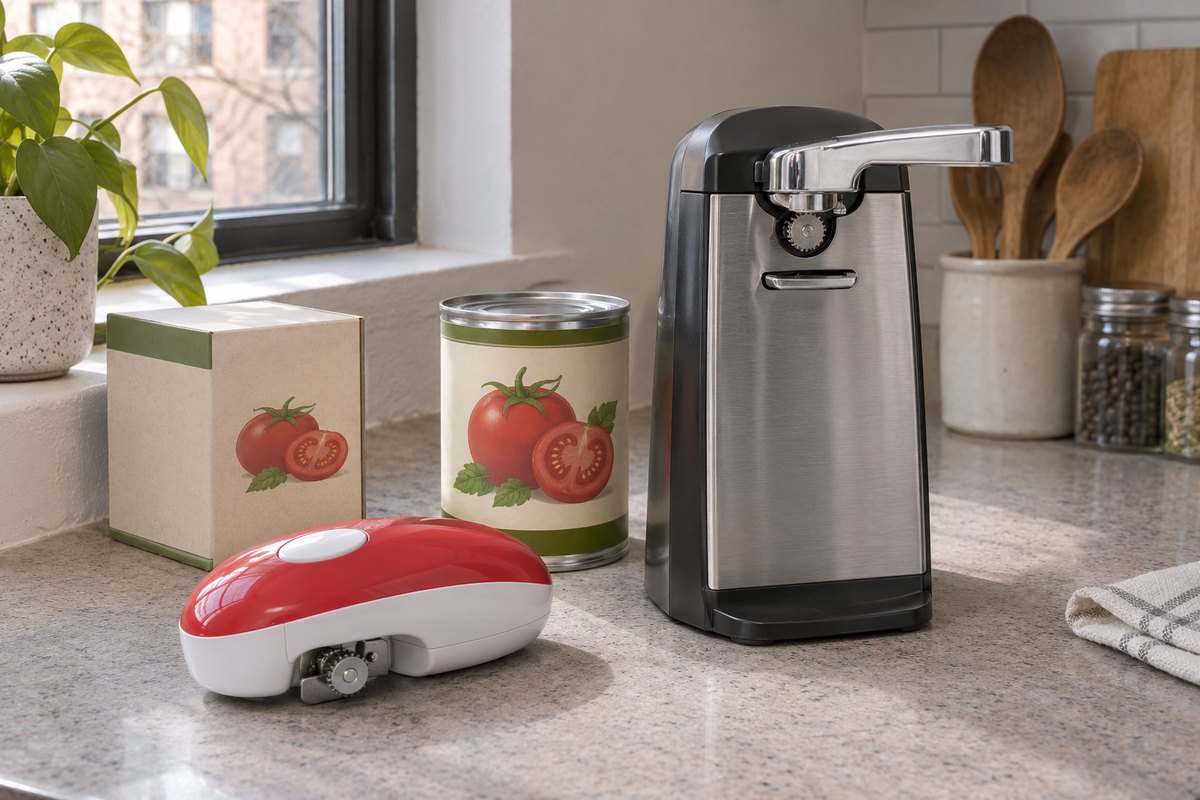
The CCO-55 gives you a fixed point to approach. You bring the can to the head instead of placing a handheld machine on top. Cuisinart describes a single-touch activation lever and a magnetic holder on the removable arm. Refer to its booklet for seating, releasing and cleaning the head. If you have room to support the full can under the lever and a clear spot to place it afterward, that layout may be more convenient than working around the rim from above. The guide to controls for weaker hands explains why the location of the control can matter as much as the effort it takes.
Notice where your free hand will be when you start. It may be holding the tin while you position the opener, or steadying the tin before it meets the Cuisinart head. If you need to complete the task with one hand, walk through those motions as well as the start button. Our one-handed opener guide separates placement, stopping and taking the lid away.
| Question | Kitchen Mama Auto | Cuisinart CCO-55 |
|---|---|---|
| Where does the can go? | On a clear worktop | Up to the fixed opening head |
| What starts it? | Top button; press again to stop | Single-touch activation lever |
| What to check for cleanup? | Cleaning directions near the cutter | Unplug before removing the lever |
Compare the specific models
We compared the manufacturers' descriptions and instructions for the models named here. We did not time cuts or measure force, so those metrics do not decide the recommendations. Product names can look similar across listings. Match the model number before using a feature or instruction described for a related version.
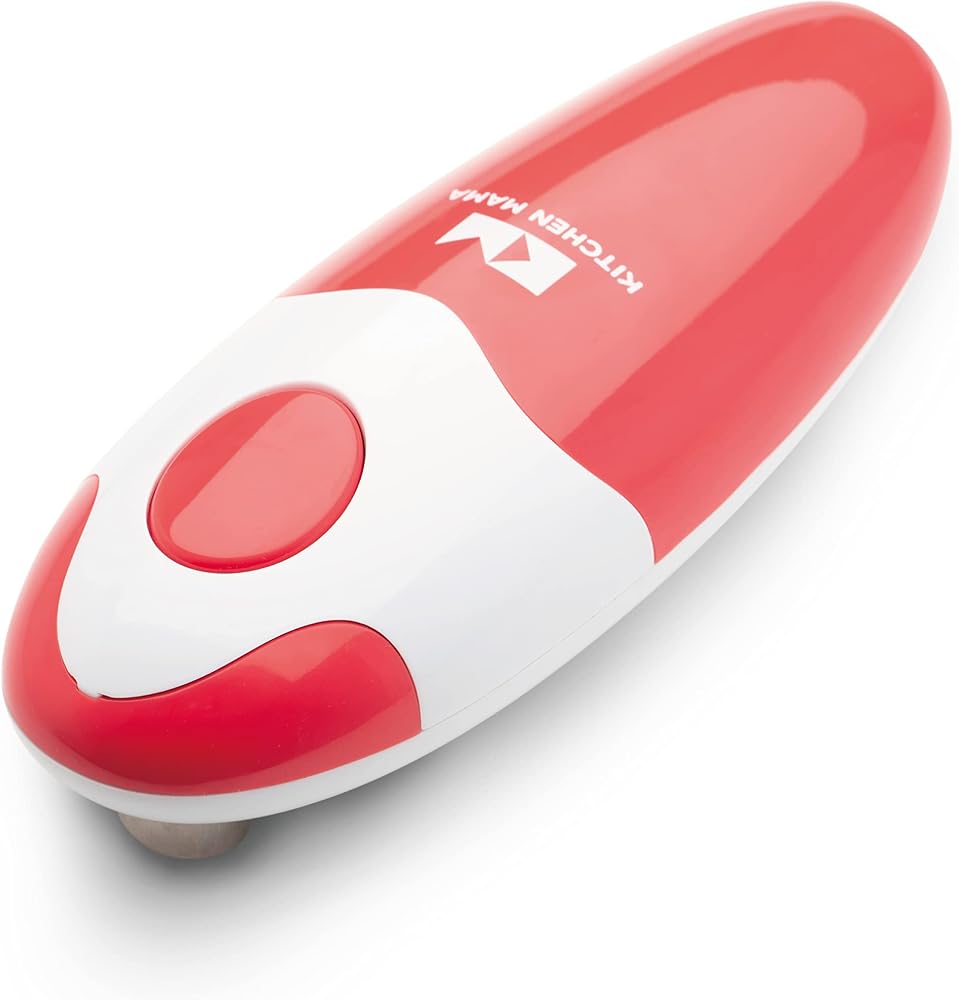
Kitchen Mama Auto, original red model: Kitchen Mama Auto Electric Can Opener Battery Operated Red
The original Auto uses four AA alkaline batteries and separate start and stop presses. It is a side-cut handheld design. Consider it if you want the can to stay on the worktop and prefer to store the opener after each meal.
View on Amazon (opens in a new tab)
Cuisinart Chrome Deluxe CCO-55: Cuisinart CCO-55 Deluxe Chrome Electric Can Opener Silver
The manufacturer lists a removable activation lever and an attached magnetic lid holder. Its stated dimensions are 4.47 by 4.62 by 9.35 inches. Use those dimensions for storage and allow additional room to bring the can up to the head.
View on Amazon (opens in a new tab)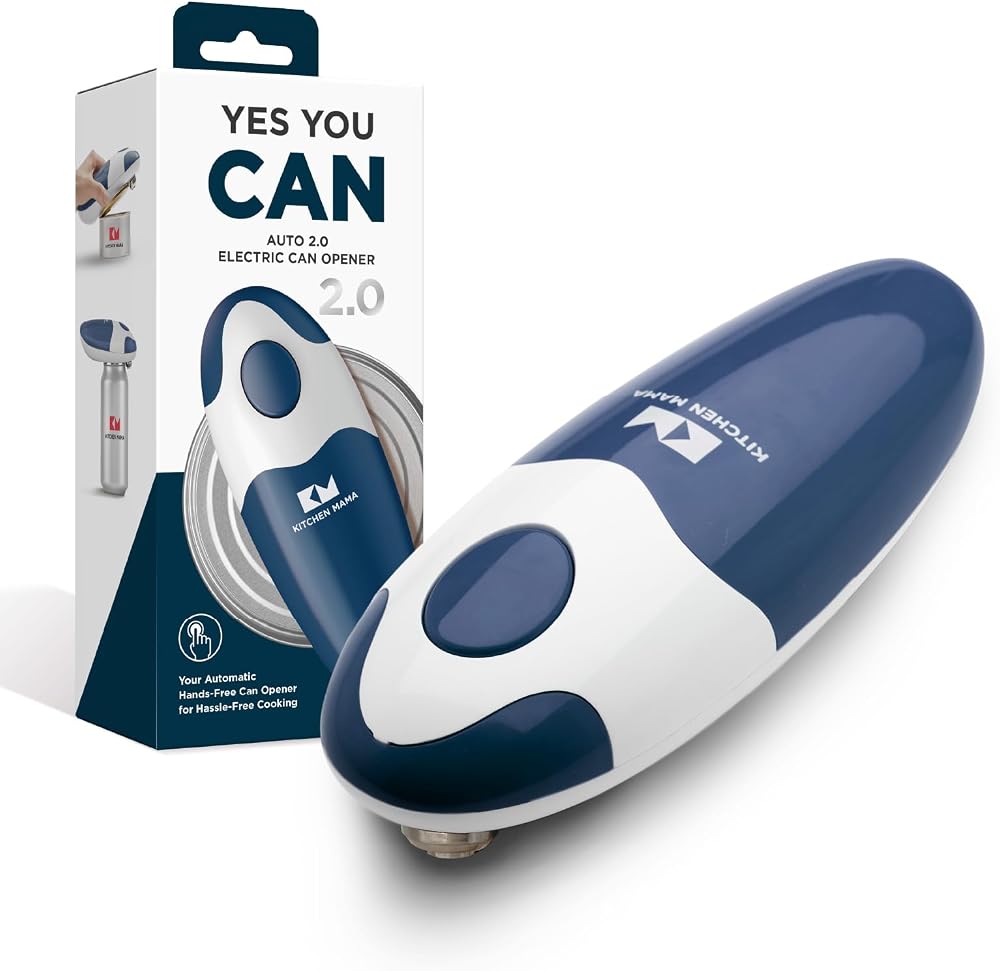
Kitchen Mama Auto 2.0 alternative: Kitchen Mama Auto 2.0 Electric Can Opener Cordless Navy Blue
The second-generation model has a revised blade for additional can shapes, according to Kitchen Mama. It still uses four AA alkaline cells and needs a second press to stop. Consider it if you have a specific compatible can style that the original Auto does not handle.
View on Amazon (opens in a new tab)- Original Kitchen Mama Auto operation and power.
- Cuisinart CCO-55 dimensions, lever and lid holder.
- Kitchen Mama Auto 2.0 blade and battery requirements.
What happens to the lid matters
The original Auto maker describes cutting along the side of the can. Cuisinart describes its Power Cut blade and a magnet to hold the lid at the arm. Those descriptions answer different questions. One describes the cutting path, and the other describes where the lid is held afterward. Check both. A tool can cut in a way you find convenient and still leave you with a lid that is awkward to put down. Keep a clear spot near the machine and follow its removal instructions rather than using your fingertips to feel the cut rim. For the mechanics, see the side-cut versus traditional comparison.
If you regularly open several cans into one pot, leave the pot beside the cutting area rather than directly under a lid that you still need to move. A standing machine is useful when you can repeat the same sequence for each can. With a handheld opener, check that there is enough room to lift it away without setting it on the next tin. What looks like a small difference in a single product demonstration can be the reason you prefer one setup after making a large batch.
Cleanup is a separate decision
The manufacturer says to unplug the CCO-55 before removing the lever. That removable part is a practical reason to consider the machine if you like handling the lever away from the body during cleanup. Follow the booklet for which surfaces and parts can be washed. For the Auto, follow the instructions for cleaning near the cutting head and battery compartment. The electric opener cleaning guide has a checklist for reading either set of directions.
Think about where the tool can dry and where it will sit between uses. If you leave the CCO-55 out, measure where the body and cord will rest and give the lever room to move. The listed body height is useful for a shelf, but it does not tell you the space needed to work under a cabinet. If you put the Auto in a drawer that contains knives or other utensils, give the motor body and cutter a separate area so it is easy to grab. Our corded and cordless comparison covers the broader storage and outlet trade-offs.
Before replacing an opener that already works, identify the part of the meal prep that you want to improve. If the awkward moment is bringing a full tin to the head, a portable motor changes that movement. If the problem is finding the handheld tool every night or replacing cells, the fixed station addresses those concerns. Compare the entire stop and release routine when switching from a model you already know. See the battery opener guide if opening the battery cover is itself a concern.
If you have a deep counter with low overhead cabinets, check reach as well as height. A tall machine may fit against the wall but leave the lever farther back than you want to reach while carrying a full can. Mark the listed footprint on the counter with paper. Then stand where you normally cook and see whether you can approach it without leaning around another appliance. Do the same exercise for the handheld tool by setting a can on the counter and leaving the surrounding space clear. You can learn a surprising amount from the layout before buying either model.
When you compare the two in a shop or from demonstrations, pay attention to the moment just before the motor starts. The movement to watch on the Cuisinart is bringing the rim up and seating it at the fixed head. On the Kitchen Mama it is finding the rim under the housing while the full tin stays on the counter. If a video cuts away at that point, look for another view or use the manufacturer diagram. A demonstration that shows only a spinning can or a moving cutter does not show how it got into position.
Use the exact can that makes you want a new opener as your reference. A small round tomato paste tin and a wider can of beans can ask you to support the weight and approach the rim differently. Compare those cans against each manual and avoid extrapolating from a different Kitchen Mama generation or a different Cuisinart model. If the maker does not describe your unusual can shape, ask about that shape before buying.
Frequently asked questions
Does the original Kitchen Mama Auto stop after one press?
The maker describes a press to start and another press to stop. Check your exact variant before following that sequence.
Which model leaves the tin on the counter?
The handheld Kitchen Mama Auto comes to the tin. The Cuisinart CCO-55 has a fixed head that you bring the tin to.
Does the Cuisinart CCO-55 have a lid magnet?
Cuisinart lists a magnetic lid holder attached to the removable arm. Follow the booklet when releasing the lid.
Is the Kitchen Mama Auto 2.0 rechargeable?
The manufacturer specifies four AA alkaline batteries for the Auto 2.0.
Can I wash the whole CCO-55?
Follow the cleaning instructions in the manual. Cuisinart describes unplugging the machine before removing the activation lever for cleaning.
Our verdict
The original Kitchen Mama Auto fits the shopper who wants to work at counter level and put the machine away. The CCO-55 makes the most sense when you can dedicate a spot to the machine, lift your usual cans to it and want a removable arm. If you are considering the Auto 2.0, look for the exact compatibility difference you need. Choose around the tin you actually buy and the movement you would like to simplify.