As an Amazon Associate we earn from qualifying purchases.
The short answer
The OXO Good Grips Soft-Handled and the black KitchenAid Classic are both conventional manual can openers with large turning knobs and a bottle-opening feature. Choose the one whose handles you can keep closed without having to change your grip halfway around the can. If the part you dislike is lifting the cut lid, compare OXO's separate Smooth Edge model. Its side-cut mechanism and lid pliers change what you do at the end of the job.
Compare the grips on a can you actually use
Take a typical can from the cupboard and look down at the rim. Imagine the cutting head sitting on it as shown in the directions. The closer the handle and knob positions are to the ones you already find comfortable, the easier it will be to judge both models. An overhead product photo tells you more about the space between your hands than a photo of the tool standing upright. A photo with the opener on the rim tells you more about whether the handles will fit your grip when you use it.
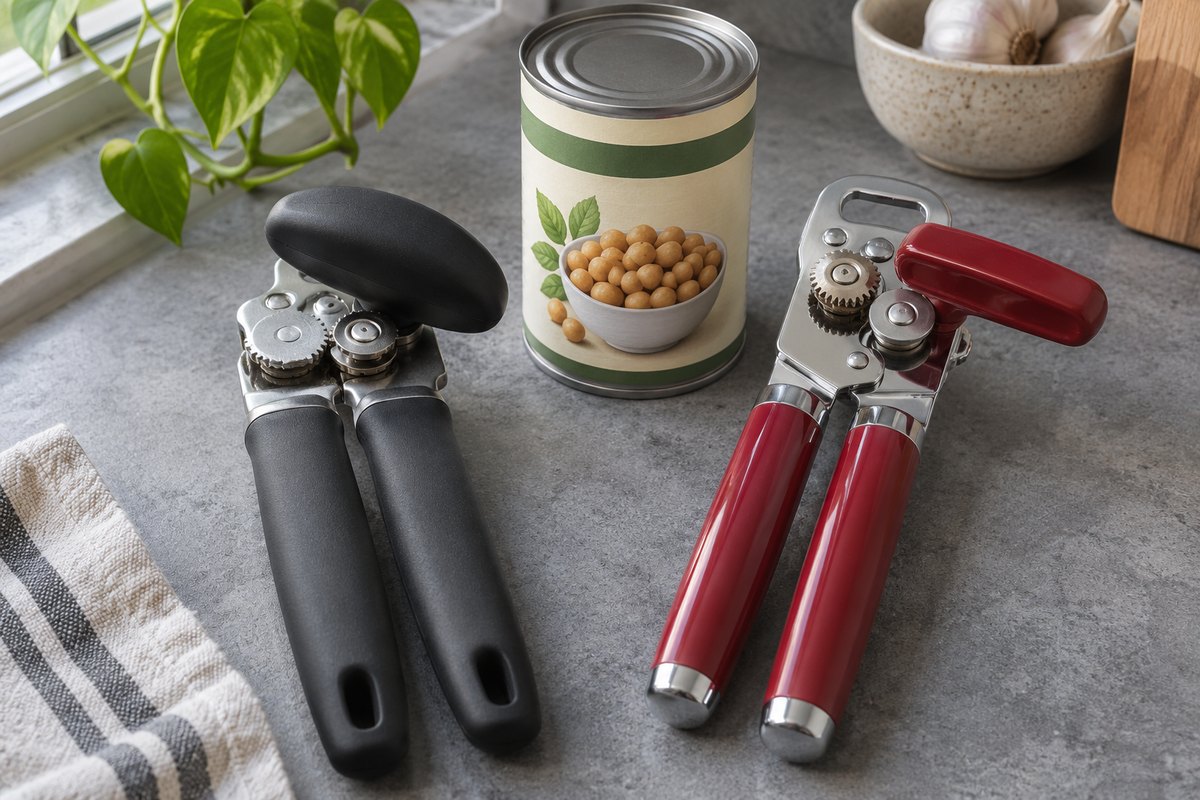
The squeeze and the turn are two separate jobs. One hand keeps the tool closed so it stays seated. The other turns the knob. A cushioned handle can change how the pressure feels against your palm. A knob with a larger surface can be easier to hold. Those two features do not establish how far apart the handles sit on a particular rim or how hard you need to squeeze. If your hand tires from holding the handles closed, a second padded tool may not change the motion that bothers you. See the electric versus manual comparison if you are trying to remove the squeeze or crank altogether.
Think about which hand naturally does each job. With the wrong working position, you can reach across the lid to get at the knob even when both grips feel comfortable off the can. Choose the side of the counter where you can see the head and turn the knob without another utensil in its path. Follow the manufacturer's orientation for the cutter. If the layout is your concern, our left-handed opener guide has a more detailed approach.
| Model | Documented feature | Decision point |
|---|---|---|
| OXO Soft-Handled | Cushioned handles and large knob | How the handles fit when closed |
| KitchenAid Classic | Soft handles and large knob | Knob position and grip on your usual can |
| OXO Smooth Edge | Side-cut mechanism and lid pliers | Whether that removal step suits you |
The two cranks and a side-cut alternative
We matched the product names to the catalog listings and compared the manufacturer's descriptions where available. For the black KitchenAid example, we used a retailer listing that identifies the same ASIN. We have no comparable force or cut-speed data for these three items. The choice here turns on the listed controls and the way each tool comes away from the lid.

OXO Soft-Handled manual: OXO Good Grips Manual Can Opener And Bottle Opener Soft Easy-Grip Handle
OXO lists cushioned handles, an oversized turning knob, a stainless steel cutting wheel and an integrated bottle opener. Look at this model first if the handle on your current opener feels narrow or presses into your palm.
View on Amazon (opens in a new tab)
KitchenAid Classic black: KitchenAid Classic Multifunction Can Opener And Bottle Opener Black
The listing for this ASIN describes a large turning knob, a stainless steel wheel, soft handles and a bottle-cap feature. Consider how the knob sits in your fingers when the other hand holds the handles closed. We found no published measurements showing it requires less hand force than the OXO.
View on Amazon (opens in a new tab)
OXO Smooth Edge alternative: OXO Good Grips Smooth Edge Manual Can Opener No Sharp Edges Soft Grip
OXO describes a wheel that cuts along the side and a small pair of pliers to lift the lid. This is a different mechanism from the Soft-Handled model. Compare it if your main concern is how the lid comes away, and read the seating instructions before buying.
View on Amazon (opens in a new tab)- OXO Soft-Handled specifications.
- Retailer listing for KitchenAid B07YP2VH4B.
- OXO Smooth Edge details and lid plier instructions.
Know which bottle feature you need
Both conventional models have a bottle-opening feature. That is handy if you buy drinks with pry-off caps and can comfortably find the cap lifter on the tool. It does not change how the opener grips a metal food tin. If your regular bottles have screw caps, check what you are actually buying the extra feature to do. For products that advertise several opening functions, look at a diagram of each one rather than assuming that a bottle tool can also twist off a glass jar lid. The guide to built-in bottle openers covers when that feature earns its space.
Compare how the lid comes away
With the two conventional cranks, check how you will release the tool and move the lid before you start. Clear room at the side of the can so you do not need to pass the lid over the food or through a crowded prep area. Follow the cutting and lid-removal directions and keep fingertips away from cut metal. If a lid that comes off a conventional cut is the reason you dislike your current tool, look at the Smooth Edge instructions before spending money on another conventional wheel. The comparison of cutting paths explains how the position of the cut and the method of lifting the lid differ.
The Smooth Edge uses small lid pliers, a separate step worth seeing in the product instructions. The fact that there is a lifting feature does not tell you how comfortable it will feel to position it with your hand. If you can try the tool in person, pay attention to reaching and moving that control while the can is on a worktop. Someone who dislikes a loose lid may find that change worthwhile even when neither of the two conventional grips is difficult.
Decide using the tool you already own
If your current opener is slipping, look at the head and the way it meets the rim before deciding that another brand will fix the problem. If it repeatedly loses contact on just one can style, verify that rim against the manual. If it struggles on several compatible tins or the pivot does not close correctly, inspect the condition of the tool. Our troubleshooting guide for slipping openers separates those causes. If you do replace it, match the new tool to the problem you noticed rather than choosing by the number of functions.
A good try-before-you-buy check is to hold an unopened tin where you normally prepare food. With no cutting underway, see how much room there is for your hand, the handle and the turning knob. The goal is a full turn without brushing your wrist against the can or countertop items. If you have access to two tools in a store or at home, compare how much your palms need to close around each handle and whether you can turn the knob without shifting your stance. That short check gives you useful information the packaging does not provide.
For a household that often opens several tins in a row, choose a dry storage spot that is easy to reach. Before buying, see how each maker says to remove food residue and dry the tool. A comfortable grip is useful only if you can keep the opener clean and in good working order. The manual opener maintenance guide explains which parts to inspect as the tool ages.
For somebody buying a second opener for a shared kitchen, the simplest question is whether both users are happy with the same motion. One person may take a loose grip on the knob and close the handles firmly. Another may prefer a knob they can turn with the whole hand and handles that require less repositioning. Try the tool from both sides of the counter. If one person struggles with holding the handles together, consider a different mechanism for that person rather than hoping a second conventional wheel will make the same motion more comfortable.
Price can break a tie if both handle layouts suit you. Compare the exact models at the same time and look for a return option if you cannot judge the grip from the listing. The extra accessory is only worth paying for if it replaces something you actually use. A plain cutting wheel with a familiar turning knob is plenty for occasional tins. If most of your pantry has pull tabs and you rarely buy plain lids, you may get more use from a small pull-tab aid than from changing the manual cutter.
Frequently asked questions
Are both standard models also bottle openers?
The OXO Soft-Handled product page and the black KitchenAid listing both describe a bottle-opening feature. Check the exact variant.
Is the OXO Soft-Handled model the same as Smooth Edge?
No. Smooth Edge is a separate side-cut design with pliers for lifting the lid.
Which is better if I struggle to keep two handles closed?
Try the handle span on a representative rim if possible. If keeping the handles squeezed is the main difficulty, a locking or powered design is worth comparing.
Does a bigger knob make the blade cut faster?
A wider knob provides more grip surface. The product pages do not establish a cut-speed advantage for either model.
How do I tell these two OXO models apart when shopping?
Look for the full name and the exact identifier. The Smooth Edge listing mentions the side cut and lid pliers; the Soft-Handled page describes the conventional wheel and bottle-opening feature.
Our verdict
Choose between the Soft-Handled OXO and the black KitchenAid by handle comfort, knob clearance and price for the exact variant. Both cover the same core jobs. If removing the lid is the step you want to change, compare the Smooth Edge mechanism before choosing either conventional tool.