As an Amazon Associate we earn from qualifying purchases.
The soft handles change the grip, and the crank still does the cut
Buy the OXO Good Grips Soft-Handled Can Opener if you already like a conventional manual cutter and want padding at the handles and a broader knob. It is a good comparison for a cook who can hold the handles closed for a full turn but dislikes the narrow contact area on an older utensil. If keeping the handles closed is the difficult part, look for a locking or powered design. If you dislike the metal disk that comes away after a top cut, a side cutter changes the operation more than a softer handle would.

OXO Good Grips Soft-Handled Can Opener: OXO Good Grips Manual Can Opener And Bottle Opener Soft Easy-Grip Handle
A conventional two-hand crank with padded handles, a stainless steel wheel and a built-in bottle-cap lifter.
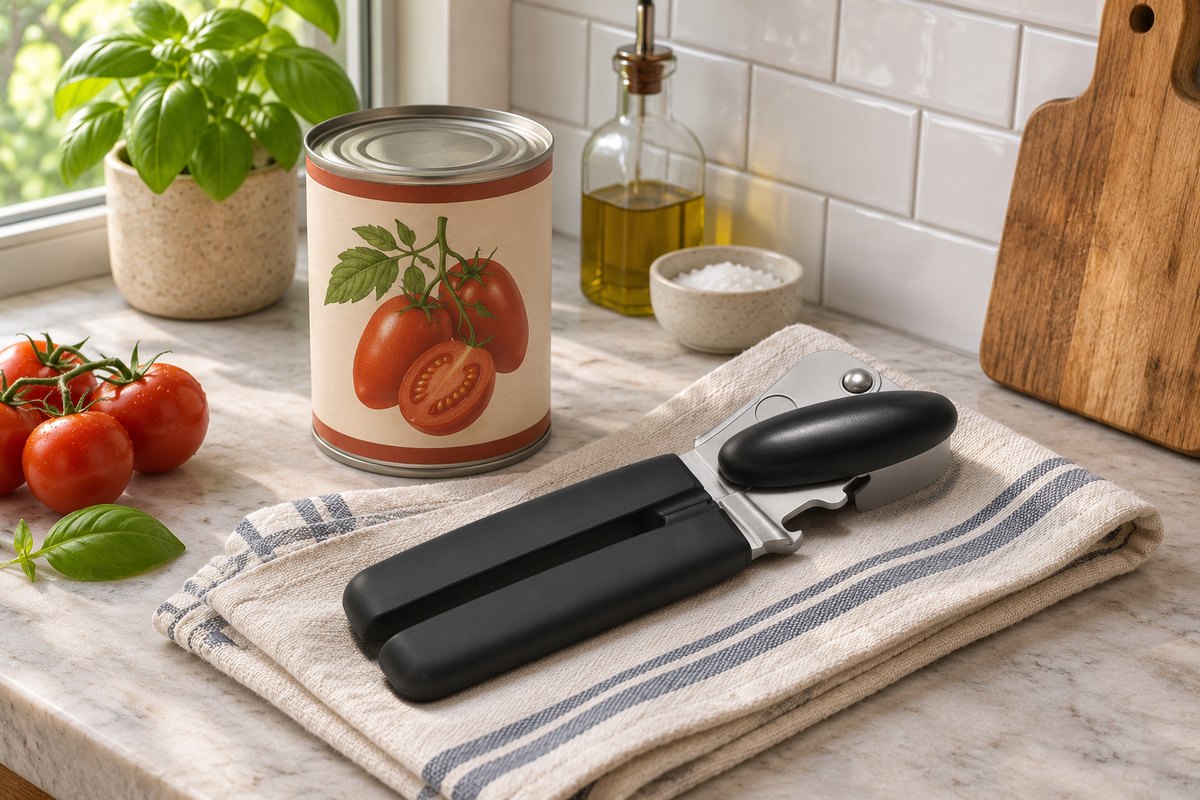
The manufacturer's product page identifies SKU 28081 and describes the padded handles, oversized knob and cutting wheel. The retailer listing for B00004OCJW specifies hand washing. Ask which option is selected if a listing includes several OXO tools. The Soft-Handled, Locking and Smooth Edge designs ask for different motions. We compared published specifications and product instructions. We did not measure force or compare cutting speed.
Check your grip with the head in its working position
One hand has to hold the handles around the rim and the other turns the knob. When comparing an older opener with this one, identify which hand is uncomfortable and when. Narrow bare metal handles may concentrate pressure on one point of the palm. The padded handles rest differently against the skin. A large knob lets you place more of your fingers around the control, though its size alone tells you little about how much force the wheel needs on your cans.
If you can handle a sample, hold it as it would sit against a can rim. Open the handles enough to imagine seating them around the lip, then see how they feel closed. A grip that feels comfortable in the closed position can still be awkward at the start if you cannot spread your hand far enough. Check how the other hand would reach the knob at that angle. Some people who comfortably use a standard crank with the knob on one side prefer a different arrangement when the tin is short and close to the worktop. See the left-hand buying guide to compare knob layouts.
If the first turn is easy but your hand tires before finishing, give that experience more weight than the initial squeeze. Think about how many tins you open in an ordinary meal. A soft handle may be enough for one can and insufficient for a cook holding the same position through several cuts. The manual and electric comparison shows what powered turning changes and what you would still have to do at the end of the cut.
There is another reason to compare the grip before buying. If different people share the opener, one may use a different hand for turning. Ask each person to seat it on a closed can as its instructions show, without starting the cut. Check whether either person has to cross over the lid or shift to an awkward position. A handle can feel comfortable in the right hand and leave the knob out of reach for someone who wants to turn with the left. A tool that fits one member of the household may be a good choice for them even if someone else needs a different layout.
Plan the lid removal and the cleanup
Seat the opener as the product instructions show on an intact compatible can. Move other utensils far enough back to turn the knob without hitting them. Keep a spot next to the can for the detached lid. The cutter follows a conventional top-cut path, so plan for the separated disk and keep your fingers away from the cut edge. If the tool slips or fails to move smoothly around the rim, stop and check the seating rather than squeezing harder. The rim-grip guide covers the checks for the head and can type.
If the lid is attached at one point after turning, keep clear of the edge. Follow the instructions to release the opener and avoid bending the lid to finish the job. See what to check after an incomplete cut. A new opener can change the grip without doing anything to prevent a lid from tilting when it comes free. Choose a separate lid-management feature if that is the problem you want to solve.
Hand wash the tool as the directions specify. Pay attention to the area around the cutting wheel after opening a tin with oil or sauce, and give it a place to dry before returning it to the drawer. If the drawer is already packed, store it with the handle easy to find and the wheel out of the way. The bottle lifter can also take the place of a separate utensil if you regularly open compatible pry-off caps. A threaded jar cap needs a different tool. See the guide to combination tools if you want the extra function.
Check the shape of the cans that give you trouble. For example, a wide, shallow tin can leave limited room between the turning knob and a chopping board. A taller can may give you more room to turn but still need to stay upright after cutting. Move both unopened cans through the places you normally use. Think about where the used lid goes and where the can will be drained. If the opener works fine and the trouble is mostly clearance, changing the arrangement may save more effort than switching to a new handle.
Compare two alternatives that change different parts of the job

KitchenAid Classic for another conventional crank: KitchenAid Classic Multifunction Can Opener And Bottle Opener Black
Compare the shape of the closed grip, the knob position and the exact model's care directions.
View on Amazon (opens in a new tab)See the KitchenAid review if you like the same basic mechanism but want to compare the handle fit. Have a look at both with their heads in the same working position. A difference in the finish or bottle-cap hook is secondary if the cutter is mainly bought for the feel of the handles. If your current tool already cuts reliably and only gets a little uncomfortable on a tall can, check the working height before paying for another conventional opener.

GoodCook Safe-Cut for an outer-seam cut: GoodCook Safe-Cut Can Opener With Easy Turn Knob Black
Use the placement diagram. Choose this alternative when how the lid comes off matters more than getting a softer handle.
View on Amazon (opens in a new tab)The GoodCook review describes its side-cut head. A different cut changes the loose lid and the removal procedure, while you still provide the turn. Compare the directions for the first placement if you have always used a conventional cutter. If you want a lock that holds the handles at the rim, check the instructions for OXO's separate locking model. An OXO logo does not establish which of those features the package contains.
If you use a manual cutter as a backup to an electric one, leave the directions near it. A different tool can require a change in how you hold the can and deal with the lid. Decide who would use it when the main opener has a flat battery or will not release. If that person already finds holding a manual crank hard, the padding may be no help during an outage or a simple failure. Compare a backup based on who will actually use it and the specific containers it will have to open.
Try a familiar intact can during a meal that can wait, and keep the return information until you know the grip suits you.
Frequently asked questions
Do the handles lock onto the can?
This model uses a conventional held grip. OXO has a separate locking model.
Can the lifter turn a jar lid?
It is a pry-off bottle-cap lifter. Check for a separate jar tool for threaded lids.
How should I wash it?
The matched retailer specifies hand washing. Check the directions with your unit.
Is this OXO a side cutter?
The Soft-Handled model is a top-cut design. OXO sells a separate Smooth Edge model.
The verdict
Choose the Soft-Handled OXO if you can comfortably clamp and crank and want padding and a broad knob. Compare a locking or powered design if sustained squeezing is the problem, or a side cutter if lid handling is the reason you are changing tools.