As an Amazon Associate we earn from qualifying purchases.
Which budget opener fits your kitchen?
If you want a manual opener that separates the lid at the outer seam, start with the GoodCook Safe-Cut. If you already like working with two handles and a crank, compare the Zulay Kitchen Comfy Grip and Gorilla Grip Upgraded. All three were below $20 in our catalog snapshot. Check the price of the exact option before buying, especially if the listing switches color or pack size when you open it. For a strict spending limit, include shipping in the number you compare.
Think of the last tin that made you replace your opener. Did the cutter slip before the first turn, did the knob become uncomfortable halfway through, or was the separated lid awkward to get out? Those are three different complaints. A larger knob addresses the turning motion. A side cutter changes how the lid separates. Neither feature tells you whether the tool will seat on a particular can. If your current opener only fails on one style of rim, try the rim and wheel checks before spending anything.
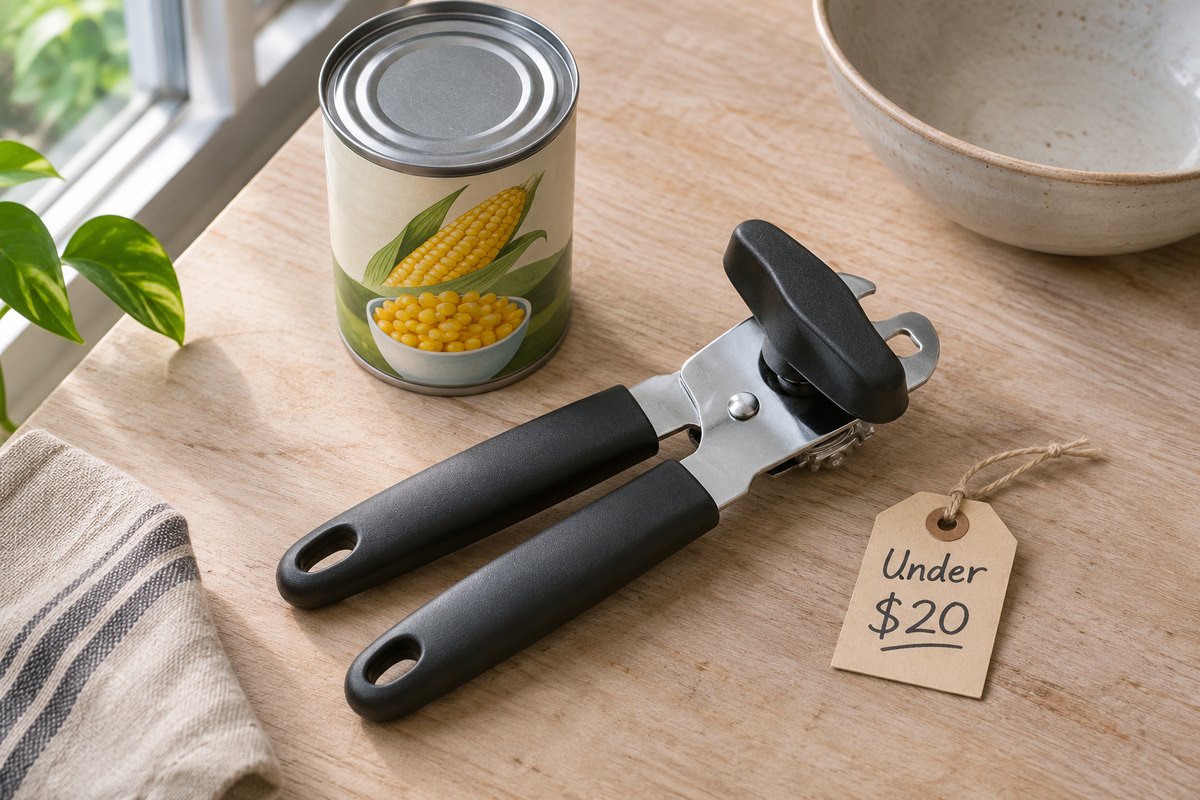
Three models, with reasons to buy each
Use $20 as the checkout ceiling. The comparison uses three US catalog entries: B000AX13US for GoodCook Safe-Cut, B0D8R9QRWL for the black Zulay and B0GH9R927H for the black Gorilla Grip Upgraded. The catalog does not preserve a collection date. The GoodCook 11834 retailer record documents the cutter mechanism, and the Gorilla Grip brand page describes its opener family. Neither is proof of a current price for every variant. If the exact option goes over budget with shipping, keep its mechanism as the comparison point and check another offer.

GoodCook Safe-Cut for an outer-seam cut: GoodCook Safe-Cut Can Opener With Easy Turn Knob Black
Start here if changing how the lid separates is your priority. The side-cut head sits differently from a conventional crank. Check the package directions before using a tin you need for dinner.
View on Amazon (opens in a new tab)The GoodCook makes the most sense when disposal is what you dislike about your old opener. If you have only used a conventional crank, set aside a moment to read the illustrated instructions. Look closely at which part of the head seats on the rim and where the cut should travel. A first try can feel unfamiliar even if you are comfortable with manual tools. Our side-cutter guide explains what to look for as the head travels around the seam.

Zulay Kitchen Comfy Grip for familiar two-handle operation: Zulay Kitchen Manual Can Opener Heavy Duty Patented Stainless Steel Black
The listed black variant has cushioned handles and an oversized knob. Choose it if you already know that a conventional clamp-and-crank tool suits you.
View on Amazon (opens in a new tab)The Zulay is worth considering if the existing tool has a cramped turning knob or narrow handles that dig into your palm. Think about the whole turn. You still have to bring the two handles together and hold the tool steady while the other hand turns. If holding those handles shut was the uncomfortable step with your old opener, the knob is the wrong feature to shop for first. Try the grip on a floor sample if you have the option, or check the return conditions before ordering.

Gorilla Grip Upgraded for a can tool with bottle-opening functions: GORILLA GRIP Manual Can Opener And Bottle Openers Upgraded Model Black
The black Upgraded variant is listed with an oversized turning knob and bottle-opening functions. Verify the exact variant when comparing it with other Gorilla Grip listings.
View on Amazon (opens in a new tab)The Gorilla Grip and Zulay belong on the same shortlist if you want a conventional manual tool. If both fit your hand, compare the total charge and where they will go in the drawer. A bottle-opening function is worth considering if it replaces a tool you reach for regularly. If you already have one on a corkscrew, give more weight to the room around the crank and how comfortably the handles close. These product descriptions give us ways to compare the designs. We did not measure turning force, blade life or grip on wet handles.
Where a cheap opener can cost you time
Picture the tool in one hand and the can on your counter. A low can of tuna puts the knob close to the work surface. A tall can of tomatoes leaves more room below the knob but can be easier to tip if the counter is crowded. If you cook with both shapes, make sure the ordinary motion works for both before you recycle the packaging. Confirm the can types supported in the opener directions. A large institutional can deserves its own checks for clearance and support.
An easy-to-store tool can still be irritating to wash if you cannot see the area around the wheel. Look for the care instructions for the exact model and follow them. Set the opener down away from the edge of the sink so the handles are easy to retrieve. Inspect the wheel area while you clean it, especially when a conventional opener has been near sauce or oil. If you are replacing a slipping tool, look for a straightforward way to maintain the new one before paying extra for another handle design.
Opening the tin is only part of the job. For a conventional crank, plan how you will remove and discard the lid without running a finger around the cut edge. A side cutter separates the lid differently, but a torn or uneven seam still calls for care. If the lid stays attached at one point, stop and check the cut instead of twisting the lid with your fingers. See how to diagnose an incomplete cut before you decide the new tool is faulty.
How to choose when you cannot try them in a store
Compare images of the exact variant with the handles both open and closed if the listing provides them. Give a photo showing the working end more weight than a badge that says heavy duty. Check whether the projected path of the turning knob actually leaves space for your fingers. If the listing shows dimensions without saying whether the handles are open, treat the width as a storage clue only. A single measurement does not tell you how far your hand has to spread to seat the tool on a tin.
Make yourself a simple return decision. Decide which two kinds of can the new tool has to open in your kitchen. Check the manual for compatibility, then try it during an ordinary prep session when you can see the cutter and put the can down easily. Think about the start, the crank and the lid separately. If you can turn it but repeatedly have trouble seating the head, exchanging the same design for a different color will do little. The manual opener roundup covers designs beyond this price limit.
A manual tool is an economical first choice if you already open cans comfortably and need a replacement. For a household where the crank motion prevents someone from opening a tin independently, it helps to show them how both types operate before you order. The extra motion of aligning a side cutter may matter more to them than the type of lid edge it leaves. A handheld powered opener can remove repeated cranking, while a countertop model may require lifting the tin. Our manual versus electric guide lays out the motions to compare.
A replacement deserves a fair comparison with the tool that wore out. If the old wheel skipped on several intact tins, check that the replacement has clear placement instructions and that the retailer accepts returns after a reasonable fit check. If your old opener worked well but the handle split, stick with that cutting path and compare how the handles meet when closed. A familiar cut is worth keeping when the trouble was a worn part.
If two people use the new opener, let each pick a different sealed can from the cupboard. One might choose a shallow tuna tin and the other a taller can of tomatoes. Those two formats will expose different problems with handle travel or clearing the lid. Keep the box until both cooks can set the tool down and retrieve the lid as directed. That is more useful than paying extra for a feature neither cook uses.
Frequently asked questions
Is a side cutter always easier to turn?
A side cut describes where the tool cuts. The knob, gearing and rim fit affect the turn. We did not compare these three models with a force gauge.
Can I use these for a glass jar?
These picks are intended for metal food cans. Use a tool designed for a screw-top jar when the container has a threaded glass neck.
Which price should I use if a listing has several options?
Use the total for the exact variant you would put in your cart. The catalog snapshot is only a starting point, and colors or multi-packs can change the price.
Should I replace a manual opener that slips once?
Check the wheel, its alignment and the rim style first. If an undamaged compatible tin repeatedly slips with correct setup, consider replacing the opener.
Our verdict
Buy the GoodCook if the people in your household want a side cut and are comfortable learning a different setup. Choose between the Zulay and Gorilla Grip by handle fit, turning clearance and the exact checkout price if you prefer a familiar crank. If you share an opener, let the person who uses it most make the call. They can tell you whether the old tool's problem was the clamp, the turn or the lid.