As an Amazon Associate we earn from qualifying purchases.
The short answer
For a basic metal food can, spend your budget on a cutting mechanism you know how to position. Choose a conventional rotary opener if you already like the squeeze-and-turn motion. Choose a side-cut model if what you want to change is the way the lid comes away. The three examples below were under $15 in our product catalog. Check the exact variant and current price before buying. A discount on another color or bundle does not establish the price of the item described here.
What a $15 budget buys
The shortlist has two conventional manual options and one side cutter. The conventional models have a turning knob and two handles. One hand keeps the tool engaged while the other turns. A larger knob gives you more surface to hold, and a padded handle gives you a softer surface to squeeze. These features can be worth looking for even on an inexpensive opener. They do not establish how much effort the tool will take on your own cans. The comparison of two conventional cranks explains how to judge the knob and handles separately.
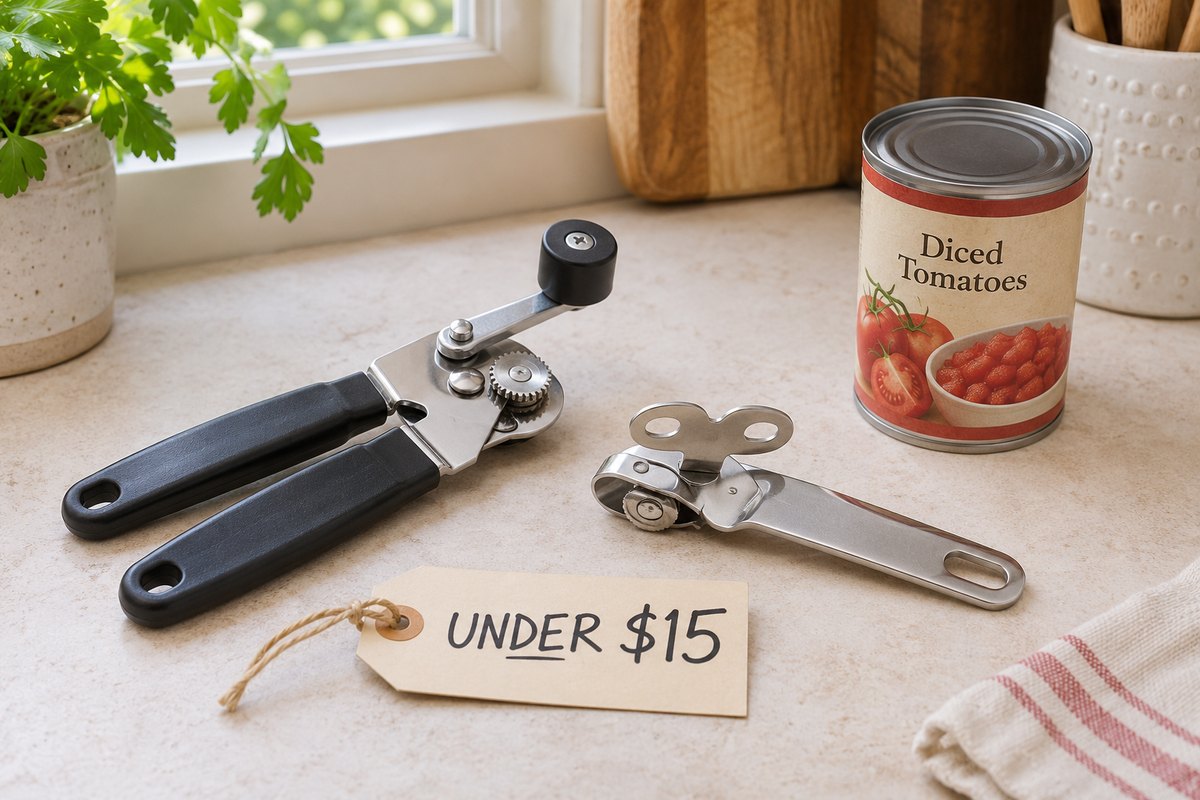
The side-cut option works in a different place on the rim. It is the purchase to consider if the lid from your existing opener is awkward to lift or falls into the can. Review the placement and removal directions before choosing it. Someone who has used a traditional wheel for years may put a side cutter in the wrong position the first time. That is a reason to read the diagram before cooking, especially if the only tin you have is the one you need for dinner. See our side-cut and traditional comparison for the two cutting paths.
| Model | Catalog price | Reason to consider |
|---|---|---|
| Gorilla Grip black | $11.98 | Conventional crank with wide knob |
| Zulay black | $14.99 | Conventional crank with soft-touch handles |
| GoodCook Safe-Cut | $11.73 | Side-cut path |
Three picks and how they differ
We used the maker's descriptions or a retailer listing for the stated model. We did not compare force, speed or durability in a controlled test. The prices are catalog references. Give the grip and cutting path more weight than a small difference in the listed price.
Verify the cart against B0GH9R927H, B0D8R9QRWL or B000AX13US. The catalog values have no recoverable collection dates. The Gorilla Grip brand page and GoodCook 11834 retailer listing can help identify product families and mechanisms. Listed prices from different channels, packs and regions do not establish a current US offer for the selected ASIN. At a strict $15 ceiling, a sold-out or over-budget offer drops off the list even if its catalog number was lower.

Lower-cost conventional option: GORILLA GRIP Manual Can Opener And Bottle Openers Upgraded Model Black
The Gorilla Grip black variant has an oversized turn knob in the listing. Try this layout if you want a conventional cutter but find a small knob difficult to hold. You will still need to close the handles on the rim and keep them engaged while turning.
View on Amazon (opens in a new tab)
Conventional option near the budget limit: Zulay Kitchen Manual Can Opener Heavy Duty Patented Stainless Steel Black
The Zulay listing describes a larger knob, soft-touch handles, a stainless steel blade and a bottle opener. At $14.99 in the catalog it has almost no room for a price increase. Compare the handle profile with the Gorilla Grip and verify the exact listing price. There is no published basis here to rank the two by effort.
View on Amazon (opens in a new tab)
Side-cut option: GoodCook Safe-Cut Can Opener With Easy Turn Knob Black
GoodCook shows its Safe-Cut opener cutting at the side. Compare it if lid removal is what you want to change. Look up the cutting position and release procedure. You still turn it by hand, and the side-cut label does not establish that it fits every rim.
View on Amazon (opens in a new tab)- Gorilla Grip manufacturer product details and exact black variant listing record.
- Zulay B0D8R9QRWL listing specifications.
- GoodCook Safe-Cut demonstration and 11834 retailer listing.
Price is the last tie-breaker
Compare one plain tin you use frequently. Imagine the tool on that rim. Notice where the turning hand would be and how much space is available for the knob. If you can hold the tool in a store, see whether the handles close around your palm without forcing a change in wrist angle. What matters is keeping the motion comfortable through a full turn, not just whether the handle feels soft while you hold the tool away from the can. If handedness changes the angle, see the left-handed layout guide.
If the two conventional options feel similar, use the current price and return terms to make the decision. Check the feature you will actually use. A built-in bottle opener can save a second tool if you often open pry-off caps. If you mostly deal with screw caps, that additional part is not a reason to buy. Our bottle-opener comparison explains the difference.
A cheap tool saves little if it does not work on the can you buy most. Look at the top of that tin and the space around the rolled rim. For a tall or wide can, check the manufacturer's directions rather than relying on terms like heavy-duty. That label is not a measurement of supported can sizes. When a can has a pull tab, decide whether you actually need a cutting wheel or would use a lever to help with the ring. The container comparison shows how to choose between a cutter and a tab tool.
Plan for the first use and cleanup
Try a new opener on a familiar intact can rather than saving it for a crowded evening or a trip. Read where the cutting head sits and what you are supposed to do at the end of the cut. If the tool loses contact, stop and check that the rim and opener match the instructions. Do not try to get through a partly cut lid by forcing the knob. The rim-grip troubleshooting guide covers common reasons the wheel may not stay engaged.
Put a plate or suitable disposal area beside the tin before you start. Keep hands away from cut metal and use the removal method described in the instructions. Clean the tool as directed and let it dry before putting it away. If several people in the house use the same tool, make the storage spot easy to reach without dragging the cutting head past loose utensils. Our manual opener maintenance guide explains which areas to check for residue or wear.
Consider the state of the tool you already have. If it seats well and your main complaint is that the knob is difficult to turn when food residue builds up, clean and inspect it as directed before replacing it. If a clean opener still slips on several compatible tins or its handles will not close securely, compare alternatives with the can you were trying to use. Spending a few dollars more on an opener with the same geometry may leave the original problem unchanged.
If the $15 limit includes everything you need, save the cart before adding nonessential items. A $14.99 tool can miss the limit with a delivery charge, while one of the lower-priced examples may leave some room. Compare the delivered cost of a single unit against local pickup. A two-pack can have a lower unit price and still be the wrong purchase when it exceeds the total you set aside.
If you are trying to stay below a firm checkout total, compare the actual basket, including any shipping cost. A model listed at $14.99 has almost no margin if the displayed figure is for another color or if you need to buy more items to qualify for delivery. Do not treat a bundle of spare utensils as a saving until you know what comes in it. If the opener is the only thing you need, the lower listed price is useful only when you can order that exact version on terms that make sense.
If the lowest-price color takes you to another ASIN, open its photos and verify the shape of the head before keeping it on the shortlist. A different image can mean a different cutting path, knob or pack size. If the seller cannot identify which one ships, move to a listing that names the mechanism you chose. Record its current total when you make the decision, because the catalog prices will not update with your cart.
If you only had trouble with one unusual tin, bring a photo of its rim to the shop or compare it to the placement diagram before ordering. This is where a slightly more expensive tool can still be a poor purchase. Confirm the fit first and then use the budget to narrow the choices.
Frequently asked questions
Are these three prices current Amazon offers?
The figures came from an undated US product catalog. Check the selected variant and price at checkout.
Is the side cutter powered?
The GoodCook Safe-Cut example is manual. The side-cut description refers to the cutting path.
Can these tools open a glass jar?
A metal-can cutter and a glass-jar grip work on different closures.
What if I cannot keep the handles closed?
A larger knob will not remove that requirement. Compare a locking or powered design if closing pressure is the difficult movement.
Why do two conventional models appear here?
They offer similar mechanisms at different catalog prices. Choose based on handle fit, knob clearance and the price for the exact variant.
Our verdict
Buy the conventional option that best fits your grip if the traditional cutting path already works for you. Pay for the side-cut mechanism if how the lid comes away is the problem you want to solve. Verify that the exact item is still under budget and that it fits your regular cans. Those checks are more useful than choosing between two nearly identical feature lists.