As an Amazon Associate we earn from qualifying purchases.
Check what the third function would replace
A three-in-one opener earns its counter space if you want a powered can cutter and will regularly use its other stations. If you already have a bottle key and a knife sharpener you like, choose by the can cutter first. For a small kitchen with little permanent counter space, a dedicated manual cutter is worth comparing if you can comfortably turn it. A dedicated countertop motor makes sense when you want powered turning and have a regular spot for it. Look at the jobs you do before and after cutting as well as the number printed on the box.
The example here is the black Amazon Basics B07T6NNKJ4, whose archived instruction booklet shows a powered cutter, a cap lifter and a blade-sharpening slot. The latter two are manual attachments. The booklet calls for unplugging the appliance before using either one. A different product advertised as three-in-one can have another combination. Check the illustrated parts for the item in your cart. We compared published directions and product layouts. We did not measure cutting or sharpening performance.
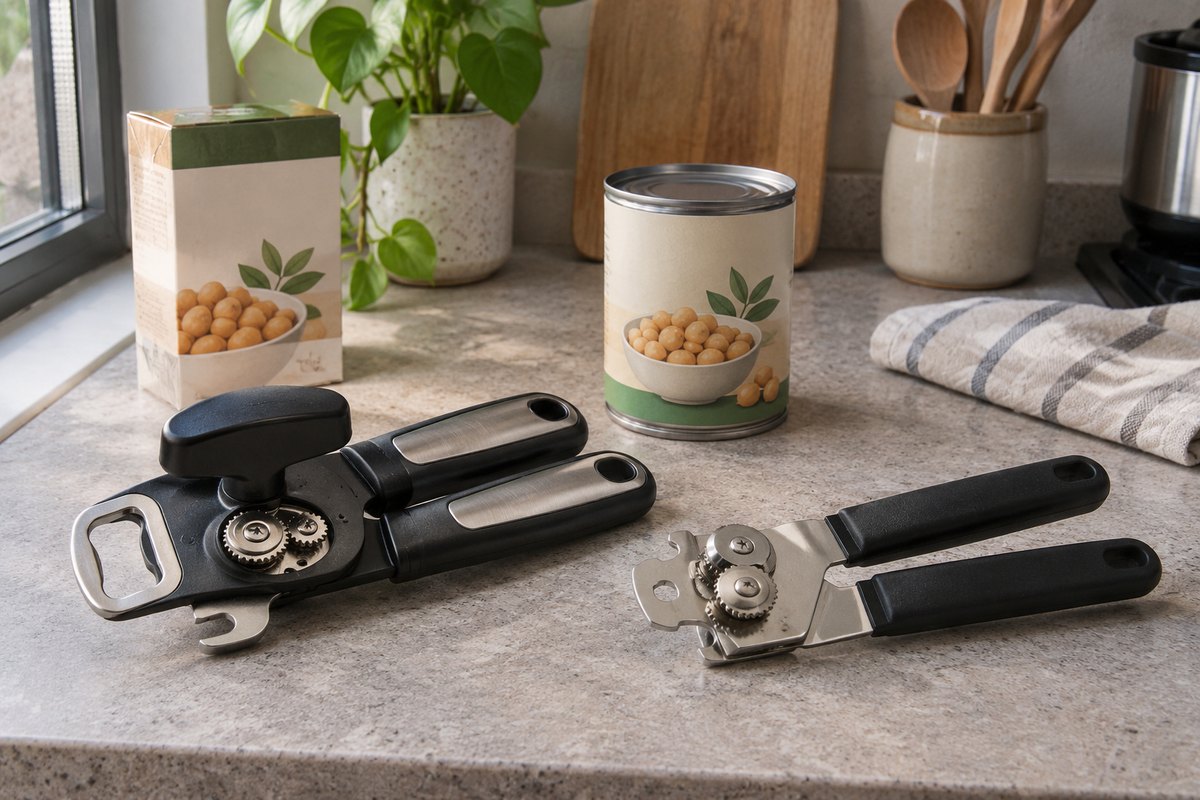
Each job needs a different approach to the machine
A powered cutter can remove repeated turning. You still have to raise the can to the head and lower the opened can securely. Look at the tallest and heaviest tins you buy, and see whether there is a useful spot near the outlet. If the machine is pushed against other equipment, check whether you can see the rim from where you normally stand. The comparison of corded and handheld designs explains why keeping the can down can be a more meaningful change than adding a sharpener.
A cap lifter needs space for a bottle to approach at the angle the instructions show. If your drinks are usually opened away from the prep counter, a separate key may be easier to find and use. A bottle with a threaded cap needs a grip suited to its closure. See the bottle feature comparison if you mainly want to combine those two opening jobs. An appliance can fit beneath a shelf while a tall bottle still cannot approach its lifter without hitting the same shelf.
Treat sharpening as a separate job. Check which blades the manufacturer supports and where the slot sits. Follow its directions for disconnecting power and supporting the appliance. Think about whether you will really clear that section of worktop in order to use it. If you already sharpen knives elsewhere or have them serviced, the built-in slot may make little difference. A feature you rarely use should get less weight than the cutting head, the lid holder or the controls you reach each time you make dinner.
A combination station can be a sensible fit for a kitchen that opens several cans during dinner and occasionally uses another attachment while clearing the same worktop. It is less convenient if guests need the cap lifter while the appliance is still being used for food prep. Work out which tasks can wait and which normally happen together. If the extra function needs the whole machine to be unplugged and moved, treat the time for that change as part of the job. If the extras are rarely used, a good dedicated cutter can leave the preparation routine simpler.
Compare the three-in-one with dedicated alternatives

Amazon Basics electric three-in-one for a fixed prep station: Amazon Basics 3-In-1 Electric Can Opener Bottle Opener Knife Sharpener Black
The archived booklet shows a can cutter, bottle-cap lifter and sharpening slot. Check the power and clearance directions for each function.
View on Amazon (opens in a new tab)The Amazon Basics is worth considering if you can leave the appliance near a reachable outlet and use the secondary features without rearranging the counter. Try placing a closed can and your usual bottle in the area where the machine would go. Check the route for the cord and leave a clear place for the opened tin and lid. If the socket is behind another appliance, consider how you will reach it before changing from powered cutting to a manual attachment.

GoodCook Safe-Cut for a dedicated manual side cut: GoodCook Safe-Cut Can Opener With Easy Turn Knob Black
A manual tool for compatible tins that separates the lid around the outer seam. Check fit and lid-removal directions.
View on Amazon (opens in a new tab)The GoodCook review explains the different head placement. Choose a small manual cutter if you want to use a clear patch of worktop and put the cutter away afterward. You supply the turn, so it is less suitable if cranking is what you want to avoid. If the loose lid is the reason you are changing tools, our cutting-path comparison explains why the shape of the detached piece matters.

Cuisinart CCO-55 for dedicated powered cutting: Cuisinart CCO-55 Deluxe Chrome Electric Can Opener Silver
Compare the fixed head, automatic stop and cleanup. Check room to raise and lower the can.
View on Amazon (opens in a new tab)The CCO-55 review describes the controls and removable assembly. Give this layout a look if you want the motor and already own your other tools. A dedicated countertop appliance can still take substantial space. Measure the working area around it before replacing a compact crank. If a full can is too heavy to lift comfortably, compare a handheld cutter rather than expecting fewer functions to solve that movement.
When buying to replace a worn motor, check whether the new head and lever suit the cans you can already handle. It is possible to like the extra functions and still find the main cutter awkward on your shortest tin. Compare the view under the head and where the can will land after the cut. If you cannot see those positions in a product demonstration, ask for the manual. A tall housing leaves a visible place to put a lever but does not establish the amount of usable clearance for a particular rim.
Make a space and cost comparison at home
Lay out the can opener, bottle key and sharpening tool you currently use. Put away anything you would definitely keep even after buying the combination. A bottle key on a corkscrew may live in the drawer either way. A sharpener that suits another cook's knives may stay there too. Compare the prices of the exact versions and count only the tools that would actually leave the kitchen. For another measurement check, see the guide for small worktops.
Cleaning can also change the decision. After opening a tin of sauce, check which parts need cleaning before the appliance is used for another job. Follow the instructions for removable parts and handle the motor housing separately. The electric opener cleaning guide covers how to read care directions for the exact tool. Leave enough space to dry or wipe the machine while the rest of the meal goes ahead.
When several people use the kitchen, ask each one where they would look for the cap lifter. A separate bottle key might work well for guests even if somebody else likes the combination. A useful appliance is one whose controls and attachments can be identified without handling the blade or guessing. Keep the directions accessible. If you would have to move the appliance often to switch tasks, consider how you would store its cord and where you would place it while it is unplugged.
Consider what happens if one part wears out. A can cutter with a failed motor may need repair or replacement even if the cap lifter still works. Separate tools can be replaced individually. Check the maker’s support and spare-part information if a heavily used function would interrupt your routine when it fails. For an occasional-use tool, storage space may matter more than serviceability. Record the exact model code rather than relying on a generic carton label.
Frequently asked questions
Are all three Amazon Basics functions powered?
The can cutter is powered. The instructions call for unplugging before using the cap lifter or sharpening slot.
Will the bottle lifter work on a screw-top jar?
Check the closure. A pry-off cap lifter is for a different mechanism from a threaded lid.
Is a dedicated cutter always smaller?
Compare exact dimensions and working clearance. A dedicated countertop machine can still need considerable space.
Which is better if lifting a tin is difficult?
Compare a compatible handheld tool that goes to the can. Fixed-head units require bringing the can to them.
Before ordering, compare the appliance with one ordinary can and bottle you already buy.
The verdict
Choose a three-in-one model if you want its cutter and regularly use the extras in the same place. Choose a manual cutter when drawer storage matters and the turn is comfortable. Choose a dedicated electric model when powered cutting is the feature you actually need.