As an Amazon Associate we earn from qualifying purchases.
Choose by the strain you want to avoid
Start with the OXO jar opener and base pad if your hand can turn a handle but the glass moves on the counter. Try the Otstar lined gripper if your fingers slip on a compatible cap and you can already keep the jar steady. Look at the KitchenMUH if you want a motor to supply the turn and can position it on the jar. Bring out a jar that gives you trouble and identify which of those movements matters most. A tool that keeps the jar steady may be enough on its own. A bigger handle can still be awkward when turning is the part you cannot manage.
The Arthritis Society hand protection guide lists nonslip material and adapted openers as options for kitchen work. This page compares how each listed tool operates; we did not measure the force required or test the devices with people who have arthritis. If you already own a gripper, try the counter setup in the weak-grip jar tutorial first. A cleaner grip or a steadier base may solve the problem without another purchase.
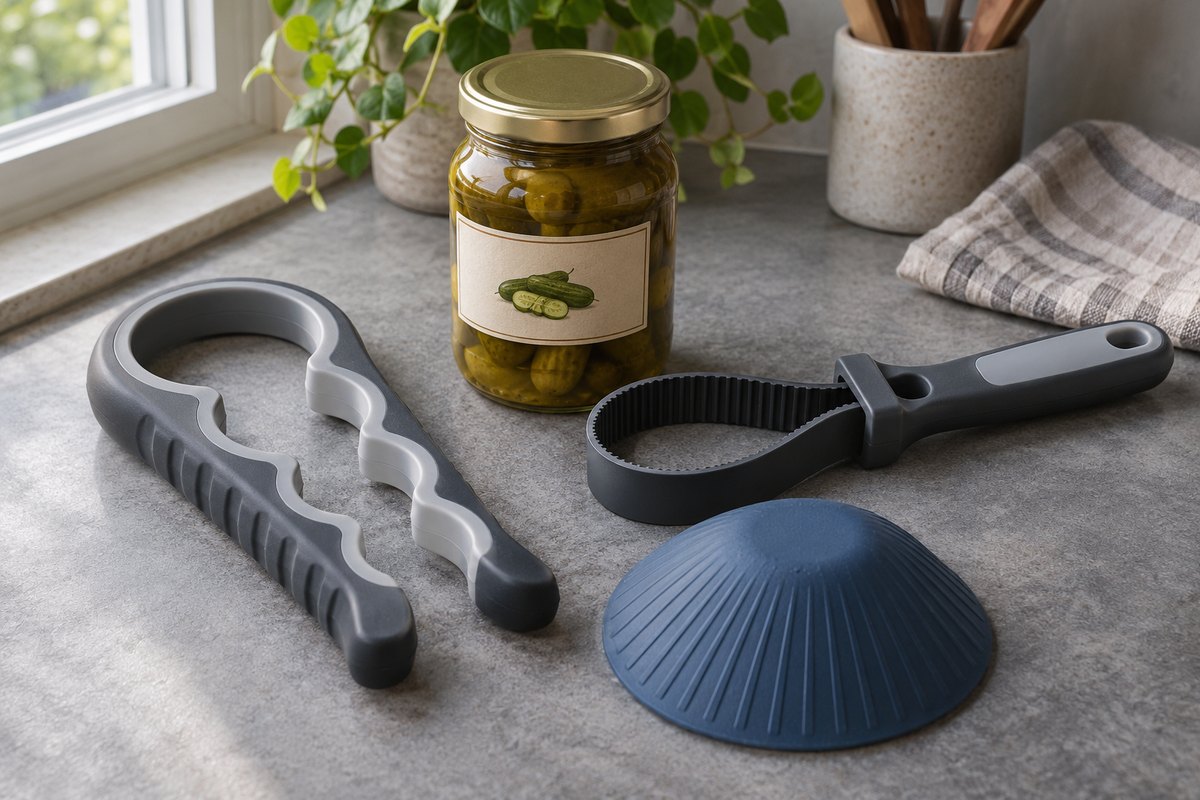
A separate base pad for a jar that rotates

OXO Good Grips jar opener with base pad: OXO Good Grips Jar Opener With Base Pad
Confirm the set includes a pad. The pad supports the base while you hold and turn the opener.
View on Amazon (opens in a new tab)The OXO base-pad guide describes the placement. This is the first design to compare if the glass spins when you apply the turn. Put the jar on the pad as directed and check where your other hand can support it. You still have to seat the opener and turn the handle. Think about the grip at the start, when you may need to hold it steady, and where the handle goes as the lid loosens. If that motion is uncomfortable even with a stationary jar, consider the powered option below.
A pad takes little storage space, but keeping it separate from the opener can make it easy to forget. Give the two pieces a shared spot by the work area. Check how each should be cleaned and leave both out to dry if their instructions call for it. If the jar is too heavy to move comfortably from the fridge, choose a counter position near where you use it. Fixing the grip on the lid cannot change how far you need to carry the glass.
Before you add a lid tool, notice how much movement occurs at the base. A broad jar that stays flat may need nothing more than a dry counter and a suitable grip. A tall narrow jar can tip if it is pushed from the top. A pad can improve contact with the work surface, but it cannot catch a jar whose weight shifts off the base. Keep the glass upright and follow the tool directions for supporting it. If the jar moves anyway, set the tool down rather than leaning against the handle. This is particularly important with a full jar that you cannot comfortably hold at the same time.
A lined gripper for a cap that slips

Otstar kit for compatible screw caps: Otstar Jar Opener And Bottle Opener For Seniors With Arthritis Weak Hands
Look for contact around the edge of your lid. Keep the jar body steady separately.
View on Amazon (opens in a new tab)The Otstar review explains how to pick the lined opening. It is worth comparing for a small cap that you can barely get your fingers around. A handle gives you another place to apply the turn. Measure the cap before choosing. If the grip touches only one edge or does not sit as shown, use a better-fitting tool instead of squeezing harder. A wider or very shallow lid may need a different head.
Do not buy the kit just because it advertises several functions. List the lid shapes you open each week. If you only need a single cap size, think about whether a more basic grip would be easier to find and place. If you have a set of different caps, make sure the package diagram covers each one rather than assuming every opening is for a threaded lid. See the adjustable gripper review if none of the fixed openings fits your usual lid.
A jar cap can have a square shoulder, shallow lip or ribbed plastic edge. When possible, compare your actual closed container with a diagram or a display tool. Look at the point where the working surface is meant to sit. The size alone cannot show whether the cap is flush against the shoulder of the glass. If a grip has to be held at an angle just to keep it on the lid, choose a layout that sits as directed. A tool that fits the cap you open every morning can be more valuable than one with more rarely used attachments.
A motor for the twist you cannot comfortably supply
Measure two jars before choosing. The OXO base-pad product page describes a separate pad that supports the glass while you turn the handle. The Otstar instruction copy gives a range for the lined openings, with a separate loosening function for some larger lids. The KitchenMUH manual copy distinguishes cap and body fit. If changing to a bigger-handled tool still leaves the wrist doing the painful turn, check the powered model’s fit and instructions before spending money on another manual grip.

KitchenMUH powered opener for measured glass jars: KITCHENMUH Electric Jar Opener For Seniors With Arthritis White
Check the lid and jar-body ranges, then wait for the jaws to return before lifting off the machine.
View on Amazon (opens in a new tab)The KitchenMUH review covers the separate jaw measurements and AA batteries. Measure the jar at the point where the outer jaws would land, and then measure the lid. A wide glass body can rule out a jar even when its cap fits the inner jaws. If the dimensions match, check that you can retrieve the tool, lower it into place and lift it when it stops and resets. Give it somewhere to sit while you remove the loosened lid.
The appliance may take over the turn, but you still have to manage setup and occasional battery changes. Put spare batteries and the directions in a reachable place. If the opener is a gift, check whether the recipient can open the battery compartment or has someone who can help with that part. For a kitchen where one person sets up a tool and another uses it, the powered jar opener guide for caregivers covers other handoff decisions.
Try to separate storage from the power decision. If the powered opener will only fit on a shelf above shoulder height, retrieving it may be harder than turning a small lid you have already loosened. Keep it on a reachable shelf or give it a drawer spot that lets you pick it up without pinching between other utensils. Check where it can be put down during breakfast. A tool that saves the turn should leave enough space to reach the spoon, lid and jar afterward. If you prefer a compact manual opener, give its handle space to swing instead of expecting it to work in the same narrow corner.
Try the routine where the jar lives
Take two closed jars from your kitchen and check how you would reach each one, steady it, loosen the lid and move the food. A jam jar you open at breakfast and a large pickle jar you bring out for guests may call for different arrangements. If the only hard step is the initial seal, you may choose to get help with the first opening and keep a small grip for later. If closing and reopening the lid is difficult every day, put more weight on a setup that can stay accessible.
A fixed under-cabinet opener changes the height at which you hold the jar. Try that lift with a closed jar before buying a mounted tool, especially if the cabinet sits above the back of a deep counter. A handheld tool may work closer to the front, provided there is room for its handle to move. The under-cabinet and handheld comparison explains why a permanent location can be helpful in one kitchen and awkward in another.
When comparing prices, check the exact variant for included parts and batteries. A listing with a pictured pad or accessory may show a different set from the one selected in the cart.
Frequently asked questions
Which tool should I try if the whole jar turns?
Start by improving contact at the base. A suitable pad can help on a dry work surface.
What if my fingers slip but I can turn a handle?
Compare a lined or adjustable gripper with the outside dimensions and shape of your lid.
Does a motor fit every glass jar?
Check both jaw ranges and the supported jar shape in the model instructions.
What if none of the movements is comfortable?
Set the jar down and ask for help or choose packaging you can open comfortably.
The verdict
Choose a base pad if the glass moves, a lined gripper if the cap is difficult to hold, or a powered opener if turning is the obstacle. Measure the containers you buy and check where each tool will live before committing.