As an Amazon Associate we earn from qualifying purchases.
Check what moves first
Set the glass jar upright on a clear, dry section of counter. With a gentle attempt at turning, notice whether the whole jar moves, whether your hand slips on the cap, or whether the cap stays put even when both grips are firm. Each points to a different adjustment. A nonslip pad can help with the glass. A lid gripper gives a larger surface to hold. A suitable powered opener can supply the turn when that movement is the obstacle. If you cannot keep the jar upright, stop and ask for help or choose another package.
This guide covers intact glass jars with threaded lids. A pull tab or a plain food tin needs a different tool. Our closure comparison explains how to tell the difference. A familiar new jar can also behave differently from the one you opened yesterday. Note whether the trouble comes from the first seal or happens every time. A tool for the initial seal alone may be of little use if your fingers slide on the cap every morning.
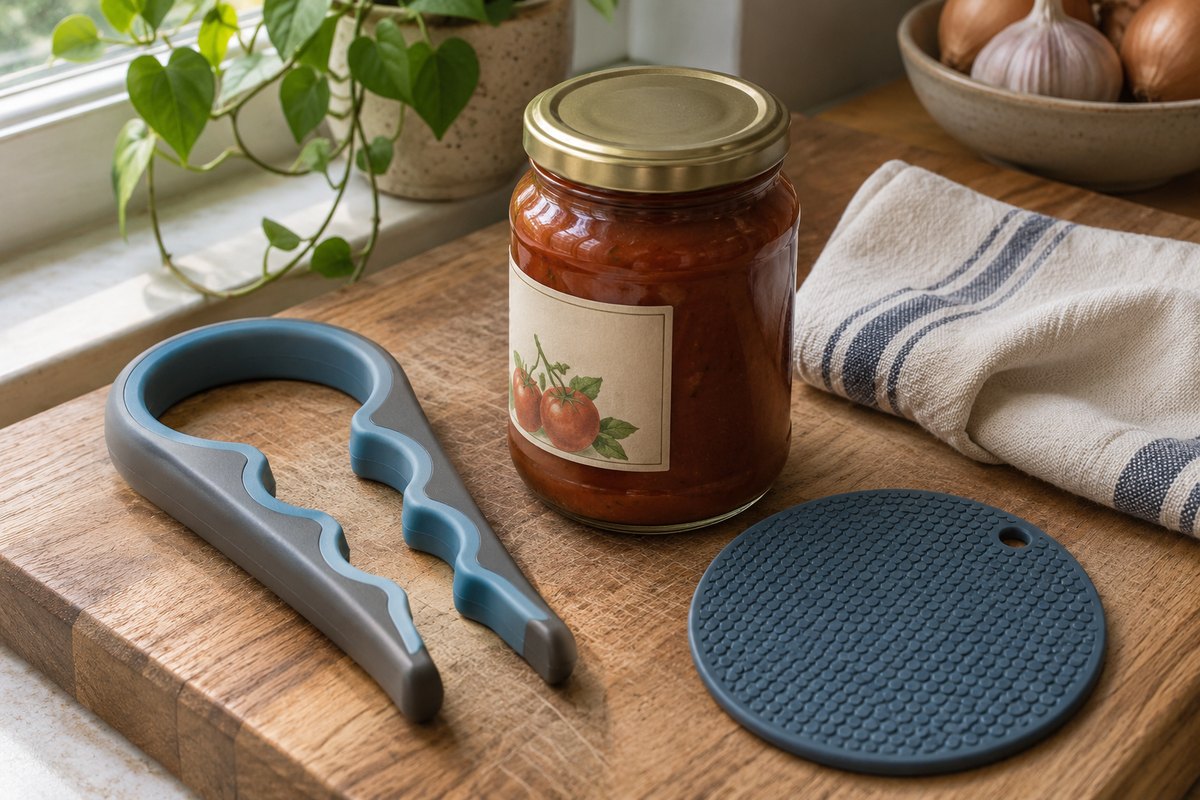
Prepare the jar and the space near it
- Set the jar on a level counter. If the glass is cracked or chipped, set it aside instead of trying to open it. Clear a place for the lid and a separate place for the tool.
- Dry the jar, lid and worktop. If the jar rotates first, consider a suitable nonslip pad under the base. Support the jar as your opener's directions show.
- Check the shape and size of the cap before trying a grip. Fit the tool as directed and leave room for its handle or housing to move. With a powered opener, keep fingers away from its moving jaws.
- Work through the turn only while the jar and tool stay steady. Stop if the grip moves or you cannot comfortably keep the jar upright. If the tool is powered, follow its stop and release procedure.
- Put the tool down after the lid loosens. Wait for the jaws to reset before removing a powered tool, as directed. Take off the lid and move the jar only when there is a clear space to set it down.
A cold jar can have condensation on the glass even when the lid feels dry. Wipe both parts and have a clear view of the gripping surface before turning. If the glass is difficult to support near the sink, try a dry section of counter where you can see the jar and comfortably reach the lid. Avoid squeezing the glass between other utensils as a substitute for a support that fits. If a tall jar begins to tip, stop. A longer handle changes how you apply a turn, while a stable base keeps the load upright.
If a tool tends to come loose at the beginning of the turn, rehearse the working position with the jar still closed. Check whether the handle runs into the wall or the dish rack on the side you prefer. Move the jar to a clear patch of counter before fitting the opener. If you work seated, check whether you can see the outer edge of the lid clearly enough to tell where the tool rests. A cap that is wide enough for the head can still be awkward to reach when the jar sits below eye level or behind a mixing bowl.
Compare three tools by the motion they change
If the jar body moves first, the OXO instructions put the separate nonslip pad under the base before the handled grip goes on the lid. If the cap slips first, match its diameter to a grip that contacts the cap securely. For a powered option, the KitchenMUH instruction booklet specifies separate jaw fit and keeping the jar supported during use. Set a second person as the support if the operator cannot follow that instruction with the available grip. Pause if the jaw placement changes when you let go.

OXO Good Grips with base pad for a jar that rotates: OXO Good Grips Jar Opener With Base Pad
A separate nonslip pad and manual lid grip. Confirm that the selected set includes both pieces.
View on Amazon (opens in a new tab)The OXO guide shows how the base and cap are handled separately. A dry pad can help when the jar slides before the lid turns. It still takes a hand to work the lid tool, and the user must support the jar as instructed. If the glass is already steady, decide whether you need a grip at the top at all. If you already have one that fits the cap, a pad may be the only addition that changes your setup. Put the two pieces away together so you can retrieve them without searching another drawer.

Otstar lined gripper for a cap your fingers cannot hold: Otstar Jar Opener And Bottle Opener For Seniors With Arthritis Weak Hands
Check which opening fits the size and shape of the actual cap. Plan how you will hold the bottle or glass steady.
View on Amazon (opens in a new tab)The Otstar review explains how its lid grip differs from the smaller accessories. Measure across the outside of the cap where the liner will contact it. If the lid is very shallow or the sides taper, the stated diameter may give only part of the answer. Check the diagram and ask about fit if it is unclear. A grip with an opening that catches only one corner may slip when you turn. For larger caps, look at the adjustable Master gripper and verify the jaw range.

KitchenMUH for a powered turn on compatible glass jars: KITCHENMUH Electric Jar Opener For Seniors With Arthritis White
Check the body and lid against the separate jaw limits. Follow the model's support, reset and removal instructions.
View on Amazon (opens in a new tab)Our KitchenMUH review lists its two measurements and AA batteries. The motor turns the lid while the jaws engage the cap and body. You still need to place the unit and lift it after the reset. Check any instructions for holding a small or tall jar during the cycle. If you cannot provide that support, plan for someone to help. The examples here describe the published mechanisms. We did not measure how much force they save or test them on every jar shape.
Keep a note of the jars you open often. Write down the brand, package size and lid diameter, since the same food can come in a taller or wider container. If several people share the groceries, note which bottle cap fits which opening of the tool. The next person can check the shape instead of trying all the slots while holding a bottle. If the container has changed, measure again. A tool that worked on last week’s package can lose contact if the new closure is shallower, even when the label looks the same.
Plan where the jar and lid go afterward
A jar that opens easily can still be awkward to pour from. Put the receiving bowl where you can set the opened jar down between movements. If you scoop out jam or mustard, bring the spoon and plate close before handling the lid. If the jar is too heavy, ask for help with carrying or pouring separately. A person may manage the lid tool comfortably and still want assistance with the glass. For a mounted option, read the cabinet-height comparison and check whether the lift is comfortable with the jar closed.
Notice what happens after the first opening. If the fresh seal is the only obstacle, somebody can help with that step and the jar can be closed and stored as directed until it is needed. If the user struggles at every meal, make the gripper easy to find and the worktop easy to reset. Keep the opener, pad or spare batteries where you can reach them. The budget guide compares simpler ways to improve contact if you do not need a powered turn.
For a first try, pick a jar that can stay closed if the arrangement proves difficult. Try placing the tool and locating the lid tray before opening the jar. If you cannot find an accessible spot to set the tool down, change the layout first. A differently packaged ingredient, a smaller jar or help with the first seal can be more useful than forcing a tool to work with one stubborn container.
Frequently asked questions
What should I try if the whole jar turns?
Dry the glass and counter. Try a suitable nonslip pad and support the jar as the tool directs.
What if the grip slips on the cap?
Check the edge depth, shape and diameter. Use a grip whose instructions cover that cap.
Can a powered opener fit any jar?
Check both the cap and body ranges and the supported shape and material.
When should I stop?
Stop if the jar tips, the tool loses contact or you cannot turn or release it comfortably.
Keep the model directions where you open jars so a helper can follow the same setup.
What to try first
Dry the jar and counter, give the glass a stable base and check the fit of the lid tool. If the base and cap both stay put but you cannot comfortably make the turn, consider a compatible powered opener or ask for help.