As an Amazon Associate we earn from qualifying purchases.
The short answer
Choose an under-cabinet opener if you can comfortably raise and support a full jar and want the lid held at a fixed point. Choose a handheld grip if you would rather leave the jar on the counter. A nonslip pad is especially useful when the glass turns before the cap moves. Decide which movement you want the tool to change before you measure for the installation or compare prices.
What each design asks your hands to do
A cabinet mount holds the cap at the underside of the cabinet. Bring a closed jar up to that position, then picture turning the glass and lowering it when the cap releases. Some people find it easier to turn the wider body than to grip a lid. The opposite can be true if the jar is heavy, slippery or too wide for a comfortable hold. An opener fixed to the cabinet is one less thing to hold, but the weight of the jar still has to go somewhere.
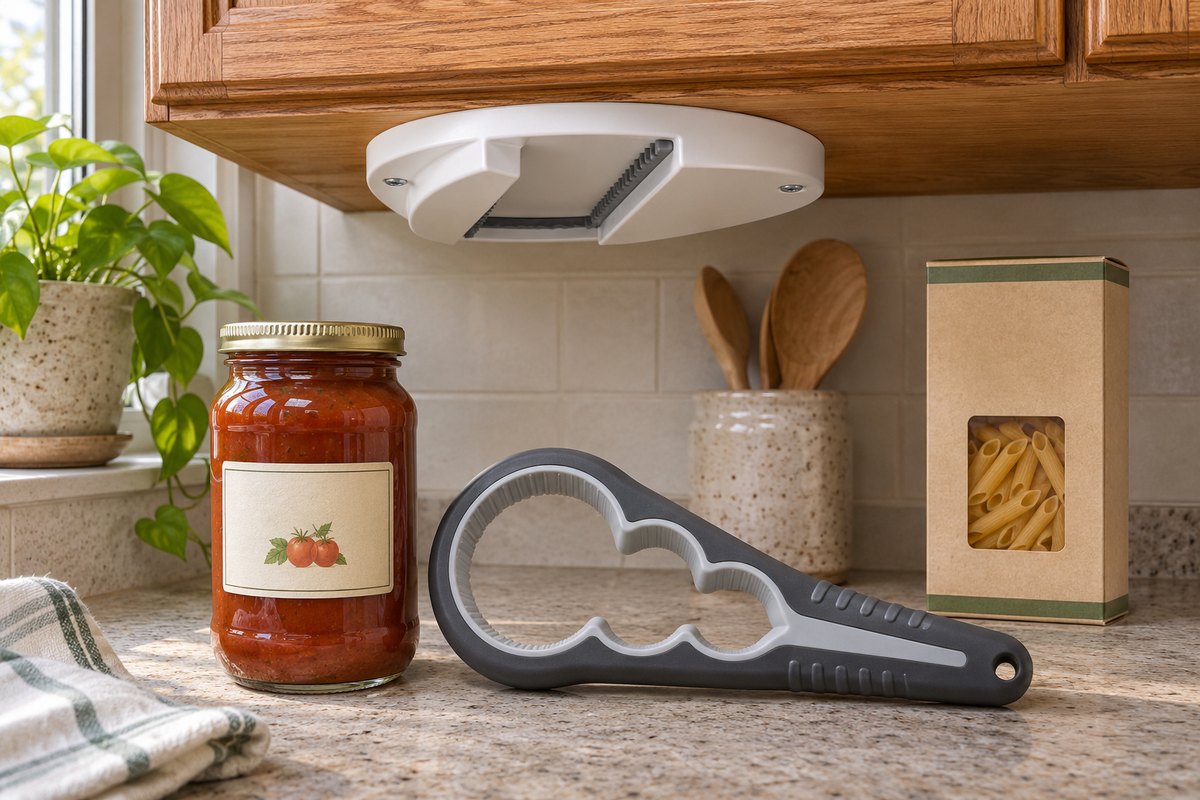
With a handheld grip, the counter can carry that weight. The handle gives you a larger surface to hold while you turn the lid. The free hand may need to steady the glass, especially on a polished surface. If the glass moves first, try a nonslip pad before choosing a larger grip. Our guide to opening a stubborn jar explains how to distinguish slippage at the cap from slippage underneath the glass.
Think about the finish as well as the first turn. A full jar has to come away from a mounted tool in control, and the cap may still be in the mount. Look at the model instructions for its release direction. If you use a handheld grip, clear enough space to put the handle down separately from the opened jar. Make that check with a tall jar and a short one. You may discover that the mounted position works well for jam but is awkward for a full jar of pasta sauce.
| Design | What stays still | What you still do |
|---|---|---|
| Cabinet mount | The cap at cabinet height | Lift, support and turn the jar |
| Handheld with a mat | The jar on the worktop | Seat and turn the handle |
| Multi-size handheld | The jar if separately supported | Match the opening and turn the cap |
Measure the position before you install anything
Start with the full jar you open most often. Hold it under the proposed spot and see where your elbow and wrist would sit while the cap meets the tool. Allow room to raise the glass, turn it and remove it again without hitting the backsplash or the things stored on the counter. If you cook from a seated position, try the movement from that position. A mount can be comfortably within reach for one person and too far back for someone approaching from lower down.
Inspect the underside of the cabinet. A front trim, light fixture or shallow strip of wood may interrupt the flat area needed for the mount. Set the published footprint against the usable surface and read the maker's instructions for compatible materials and hardware. Confirm what the screws would enter and whether installation is allowed if you rent. If you are uncertain about the surface or mounting requirements, use a handheld design rather than improvising a fastening method.
For handheld use, the critical space is beside the jar rather than above it. A longer grip needs room to swing without hitting the backsplash or a countertop appliance. Use the counter where you can see the lid and support the jar. Our OXO base-pad review explains how the separate grip and pad fit into this arrangement. If lifting the jar would be difficult but the lid also requires more turning effort than you can manage, see the guide to powered and mounted options.
Three models with different setups
The examples below use the manufacturer or retailer information for the exact model where available. We compared published dimensions and how the tools are intended to grip. We did not measure force or installation strength. Verify the size of your lids before ordering and use the instructions for the mounting surface and fasteners.

ReneeChef: try handheld before mounting: Jar Opener For Seniors Easy Grip Under Cabinet Opener For Weak Hands Arthritis
The exact listing describes both handheld and under-cabinet use, a lid range of 0.6 to 4.2 inches, dimensions of 8.3 by 5 inches and three mounting screws. Check the flat area and the space to turn a full jar before deciding where to install it.
View on Amazon (opens in a new tab)
OXO: support the glass on the worktop: OXO Good Grips Jar Opener With Base Pad
SKU 1173600 pairs a handheld grip with a separate nonslip pad. The manufacturer lists dimensions for the tool but does not give a maximum lid diameter on the cited page. Confirm fit if your usual sauce jar is particularly wide.
View on Amazon (opens in a new tab)
Otstar: store it in a drawer: Otstar Jar Opener And Bottle Opener For Seniors With Arthritis Weak Hands
The instructions describe gripping openings for 1 to 3 inch lids and separate hooks to loosen seals on larger caps. A larger cap is not automatically covered by the main grip. Use a separate pad if the glass needs help staying still.
View on Amazon (opens in a new tab)What to compare if two people share the same kitchen
Try the cabinet position with everyone who will use it. A permanent spot saves a trip to the drawer, but it fixes the working height. Someone who opens jars often may be happy with that station. Another person may find the handle-and-pad arrangement easier because the counter supports the weight. Let the person who usually opens the heaviest jar try the lift first, since that is the task the mount cannot remove. Our jar opener roundup compares alternatives by the motion they change.
For a low-use kitchen, check which piece would be easy to find next time. A handheld grip beside the utensils is simple to put away, but storing the nonslip pad on another shelf can turn a two-piece solution into a search. A fixed gripper stays in one place, but you still need room to use it when a kettle, mixer or stack of bowls is on the counter below. Look at the working area as it will be during dinner prep, not just after the counter has been completely cleared.
If you are shopping on a firm budget, include anything the setup still needs, such as a separate pad. Compare the price of the exact variant and check which pieces come in the box. The under-$15 guide shows where a simple grip may be a better use of the budget. If you also struggle with plain metal tins, see the comparison of jar grips and can cutters before assuming one tool covers both.
Try two jars before choosing a location
Use an intact jar of jam for the first rehearsal and a taller jar of sauce for the second. Keep both lids closed. With each jar, start at the place you would normally put groceries after taking them from a shelf. Move the jar to the planned opening point and back again. Notice whether the lid meets the underside of the cabinet before your hands run out of room. The taller jar can expose a clearance problem even when its lid is no wider. If the route crosses something you use every day, such as a kettle, locate an alternative spot before marking the cabinet.
Then try the same jars at counter level. If you already have a nonslip pad and a grip, put the pad under the jar and check whether you can get the handle into position with the jar fully on the worktop. Give the handle a clear arc and place a bowl or spoon where you will use it afterward. If you find yourself moving the jar around just to get the lid tool on, try facing another direction at the same surface. The best place to store the grip may be different from the best place to use it.
Use what you noticed to make the purchase decision. If the mounting height was the obstacle with the full jar, a stronger lid grip under the same cabinet will not change that height. If the handheld tool was easy to turn but the jar kept sliding, start with the pad. If neither position fits the jar you use, keep the measurements to check against the next model instead of buying another tool by appearance.
Frequently asked questions
Does an under-cabinet opener take the weight of the jar?
It grips the cap. Plan to lift, steady and lower the full jar yourself.
How do I check if the mount will fit?
Measure the clear flat surface, jar height and working space. Verify the required fasteners and surface with the model instructions.
Can I use a handheld grip with a nonslip pad?
Yes, if the jar is upright and fully supported. The pad helps resist the jar turning as you work on the cap.
Does the same tool work for narrow and wide lids?
Only within its stated fit range. Measure both lids and compare the exact specification.
What if turning is still difficult with either design?
Compare a powered mechanism and check the setup and release steps. The motor changes the turn but you still need to position the tool.
Our verdict
Pick a mount if you can lift and support a full jar at the proposed height and want the cap held in one spot. Pick a handheld grip and pad if you need the worktop to carry the weight. If neither reduces the movement you find awkward, identify whether the issue is holding, lifting or turning before you buy a different mechanism.