As an Amazon Associate we earn from qualifying purchases.
Best options at a glance
For occasional #10 cans at home, start with the Kitchen Mama Orbit One, whose maker explicitly lists #10 compatibility. For a prep bench that handles tall tins regularly, compare the Edlund #1 11100 and its mounting requirements. For larger household cans that still meet the Cuisinart CCO-55 instructions, consider that upright model only if the full can fits below its head and you can support it at the lever. These are three different ways to set up the work. The choice comes down to the can you buy, how often you open it and where it can stay supported.
Measure the tin and the working area
Write down the height and diameter of the largest closed can you actually use. Take a photo of the rim. A stated height limit tells you one part of the fit. It does not confirm that the cutter will seat on a particular seam or that the base has room around it. Equally, the published dimensions of an appliance tell you how much room its body takes up, not the largest can that fits below the cutter. Before ordering, find a fit statement for your exact model and compare it with the tin. If you cannot confirm a shape, ask the manufacturer using the model and a photo of the unopened can.
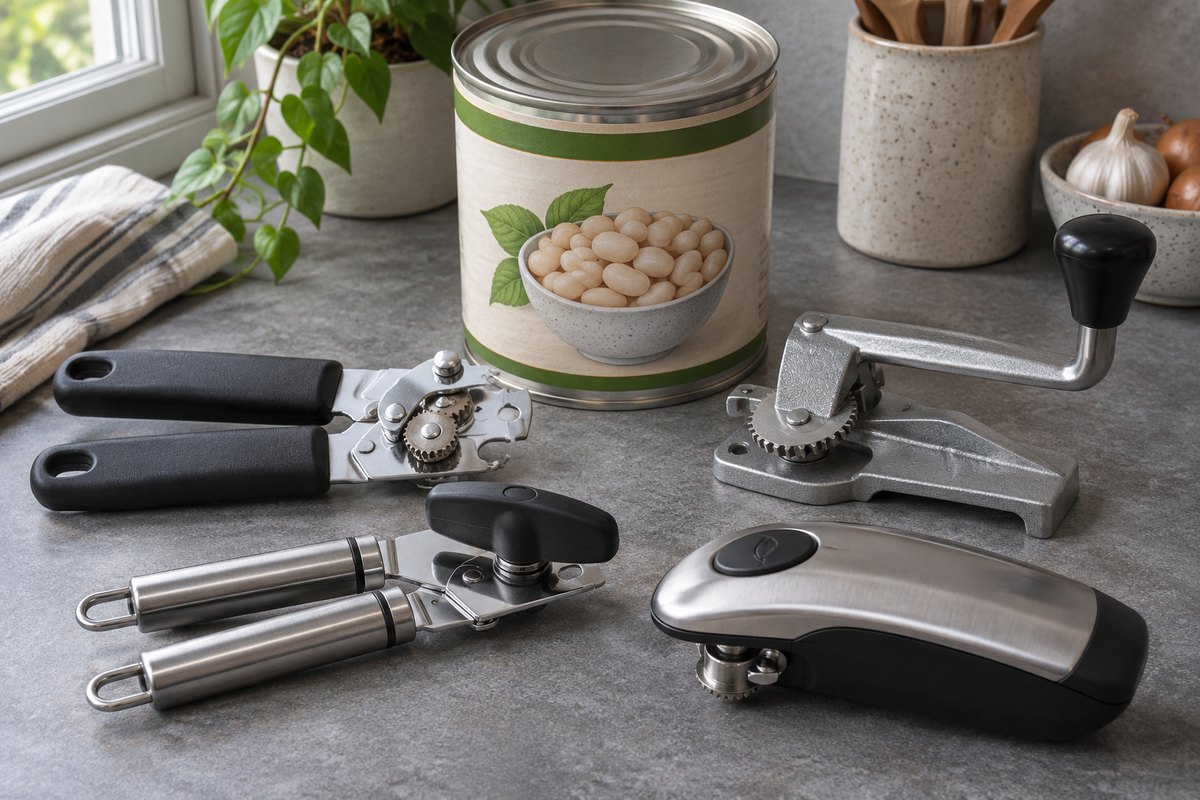
For an upright electric opener, picture the full can coming up to the head. The spot where the appliance fits may be too cramped to raise the can and then lower it again. For a handheld opener, picture the tin staying still while the tool travels around it. You need room for that travel, and you still need a clear place for the lid when it comes away. Our guide to opening large cans at home covers measuring and planning the transfer into a bowl.
| Tool | Published fit | Main consideration |
|---|---|---|
| Orbit One | Manufacturer lists #10 cans | Recharge and allow the tool room to travel |
| Edlund 11100 | Supplier lists up to 11 inches tall | Mounting surface and handle travel |
| Cuisinart CCO-55 | Standard-size cans | Confirm clearance and support full can |
Which tool makes sense for your kitchen?
We used manufacturer descriptions, operating instructions and foodservice listings to compare documented fit and installation. We did not test cutting speed, motor endurance or the number of tins any model can open in a shift. Start with the published fit guidance and choose the layout you can actually use.
Handheld option for occasional #10 cans: Kitchen Mama Orbit One Rechargeable Electric Can Opener, Red
Kitchen Mama's lineup specifically lists #10 compatibility for the rechargeable Orbit One. The red listing is identified as B0CX1HZYD7. Use its manual for charging, positioning and release. The original AA-powered Auto is a different product, so do not carry this fit claim across to it.
View on Amazon (opens in a new tab)Mounted manual option for tall cans: Edlund 11100 #1 Old Reliable Manual Can Opener
Edlund documents the #1 foodservice design, and the 11100 supplier listing puts the height limit at 11 inches. Verify the base and installation instructions before ordering. It takes a dedicated work area and still uses a manual handle.
View on Amazon (opens in a new tab)
Countertop option for compatible household tins: Cuisinart CCO-55 Deluxe Chrome Electric Can Opener Silver
Cuisinart describes the CCO-55 for standard-size cans. Its removable lever and fixed head suit an outlet-equipped prep station. Buy it only if the maker confirms your usual can fits. This recommendation does not assume #10 support.
View on Amazon (opens in a new tab)When the bench-mounted option earns its space
If you open tall stock tins repeatedly, a dedicated place on a prep bench can make sense. Before deciding where to mount a tool, use the manufacturer's instructions to check the surface and fastening requirements. Include the full handle movement above and beside the head. A mount that fits the edge of a counter can still be awkward if a cabinet or shelf blocks the operator. Put the container for the food nearby so you can set the opened can down without carrying it across another workstation.
Look at the maximum amount of work you will do on a busy day. A household that opens one large can for a gathering makes a different choice from a volunteer kitchen that opens several large tins every weekend. In the second case, check the maintenance directions and availability of the parts the maker identifies as replaceable. Edlund documents a replaceable base insert for this line. That is a practical consideration if the tool will stay installed for years. A product listing using the word heavy-duty without a service diagram leaves more questions open. See our guide to selecting a tool for commercial prep for the checks that become more important at higher volumes.
When a handheld or household model is enough
A handheld model lets you keep the can on a stable worktop. That can be useful when the can is heavy but you can still position and remove the opener. Measure the space beside the tin for the tool to travel. Find out what it does when it stops and how to release it before the first use. If the opener will wait in a drawer between large jobs, check how you will charge it before you need it. Our guide to battery-powered designs explains why removable-cell and rechargeable models need different preparation.
If your can meets the CCO-55 instructions and you have room to raise it, a fixed household cutter may already be enough. The CCO-55 review explains the lever and lid holder. If lifting the full tin to the head is awkward, compare what changes in the corded versus cordless guide. Look at removal as well as starting. A large lid needs a place to go before you move the full open can.
A different package can solve the problem at lower cost. If one recipe calls for a larger quantity than usual, use several smaller cans that are compatible with the opener you already own. It also gives you smaller containers to lift and fewer reasons to buy a tool that needs a new storage or installation space. For a household that uses bulk tins every week, record the sizes you buy and see which published fit requirements cover all of them before keeping either design on the shortlist.
- Kitchen Mama lineup and #10 capacity and Orbit One manual by ASIN.
- Edlund #1 documentation and 11100 foodservice supplier listing.
- CCO-55 product information.
Compare the full cost of each setup
List what you would need to use the opener on its first day. For a handheld rechargeable model, check the charging requirements and where you will charge it. For a bench tool, check whether the listing includes the base shown in the photographs and which installation parts the manufacturer calls for. A household upright model also needs a clear route to an outlet, but it does not need a permanent mount. These details can make two offers with similar prices quite different in practice. Read the exact product title and package description before comparing prices across sellers.
Think through a large meal before choosing. For a pot of chili that uses one oversized tin, a fully supported counter setup can be enough. You can open the can at the worktop, set the lid aside and transfer the contents to a bowl. A kitchen preparing several such dishes may value a known setup that does not have to be cleared for each batch. In that case, check where the mount would go, who can reach the handle and where each full can can be placed before and after opening.
If you are ordering online, ask the seller to confirm the model number and the largest rim it is meant to accept. Send the size of the closed tin and a photo of the rim if the published information leaves the fit uncertain. Do not count a generic yes about large cans as confirmation of your specific package. A tall, narrow can with generous clearance still needs a rim the cutter can engage. A wide can with a compatible rim may still be awkward if the handle or body has no room to travel.
Keep the photos and measurements with the recipe or pantry list if you buy in bulk. You can use them to check replacement packages before a gathering, when a different brand might be the only option. Small tins that you already know how to open are a useful fallback. Our five-step buying checklist brings the same fit and storage checks together for ordinary pantry sizes.
Frequently asked questions
Does every Kitchen Mama opener support #10 cans?
Kitchen Mama explicitly lists #10 compatibility for Orbit One. Do not extend that claim to other models.
What does the Edlund height limit tell me?
The supplier lists the 11100 for cans up to 11 inches tall. Verify the rim and the installation separately.
Can the CCO-55 open every large household tin?
The manufacturer describes standard-size cans. Check the exact can with the maker when clearance or rim fit is uncertain.
When does a mounted cutter make sense?
It is worth comparing when you handle tall tins regularly and have a suitable dedicated prep bench.
What if I only use a large can once?
For a single recipe, smaller compatible tins can give you the amount of food you need without new equipment.
The final decision
Choose by verified fit, then by how you will support the can. Pick the Orbit One if you need a documented handheld #10 option and can manage charging and release. Compare the Edlund for a permanent bench setup and confirm the mounting and can requirements. Keep a household countertop opener for cans the manufacturer confirms it can handle.